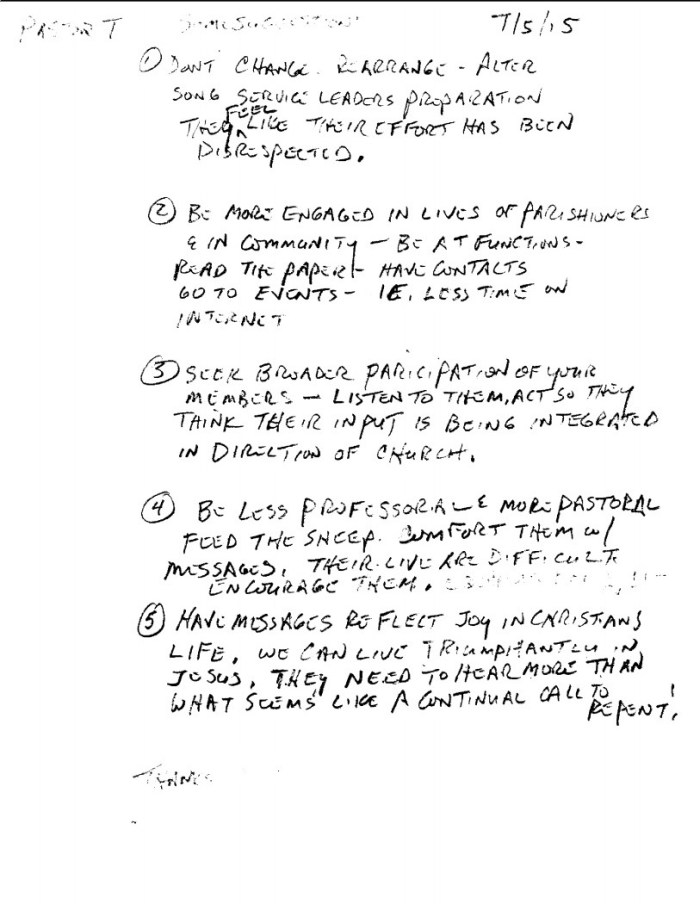
Exhibit I. Notes & Reflections on Interviews, Oct. 2015.

[Return to Table of Contents.]                                                        [Exhibit J.—>]

‘Remember your word to your servant,
    in which you have made me hope.
 This is my comfort in my affliction,
    that your promise gives me life.

Your statutes have been my songs
    in the house of my sojourning.

Teach me good judgment and knowledge,
    for I believe in your commandments.

How sweet are your words to my taste,
    sweeter than honey to my mouth!
 Through your precepts I get understanding;
    therefore I hate every false way.

Your testimonies are my heritage forever,
    for they are the joy of my heart.

The unfolding of your words gives light;
    it imparts understanding to the simple.’ 
–Ps. 119:49-50,54,66,103-4,111,130.

‘If one gives an answer before he hears, / it is his folly and shame.’  –Prov. 18:13

By mid-September, the stress had become overwhelming. I needed to get home to support my dad, and hear for myself what was going on at A. Between 7th and 13th of October 2015, I managed to arrange 4 different meetings with 6 people, plus one impromptu visit with a family friend. One meeting included two members of the council. Below are some summary comments from and on some of these conversations, written in mid-October. Some are direct quotes, some gists, juxtaposed with others (either comments made to me or to another witness, not necessarily at the time I was home); some are humorous exaggerations of remarks or conversations to illustrate the frustrations or absurd quality of some of these interactions. I was home over one Sunday—one of the council members, who was later admitted to have been among those clamouring for my dad’s removal, hugged me as if everything were normal and said he/they loved me.

I must say I was very grateful to those who agreed to meet with me. As I’m now perhaps in hot water (or no water?) with half of them, I’m grateful to God for these opportunities for information-gathering.  Now, the tone is often very reactive and sarcastic, but where I note below, many of these points are direct quotes, which are valuable evidence and provide helpful insight.  Also, there are memory-jogging references to a few events that took place around this time, including, for example, my dad’s unilateral ‘dismissal’ and exclusion from the youth Sunday School.

From October 2015. Contradictions, Ironies, and Confusion.

I don’t think the answer is to get a new pastor. I hope nobody’s thinking that.’ Vs. ‘He wants you gone. No question.’ Both direct quotes.

13 wants you gone. No question.’ Vs. ‘I know 13’s heart…13’s just trying to help and it’s not appreciated.’ Both direct quotes.

10’s trying to rein in 13.’ Vs. ‘13 just feels attacked for trying to help.’

On council meetings: ‘13 feels attacked.’ Vs. (pastor:)‘I go in there and I feel like it’s 6 against 1.’

(other council members) ‘We don’t get it. We know they’re wrong.’ Vs. (13)‘I’m not going to debate.’

Direct quotes from the same person, 8 months apart: ‘He’s such a great teacher, he’s been equipping the saints.’ Vs. ‘He’s a good Bible teacher, but he’s not a pastoral preacher.’

Direct quotes (different speakers): ‘He’s a good Bible teacher, but he’s not a pastoral preacher.’ Vs. ‘He’s probably the best pastor this church has ever had.’

Direct quotes (different speakers): ‘These are smart people…they need something relevant…they need triumph…they want to live the abundant life.’ Vs. ‘They aren’t that smart. They won’t rise to the challenge. They’re immature.’

Direct quotes (different speakers): ‘We’ve handed off suggestions to the minister.’ Vs. ‘I know we have people who are [part of the] problem. They bring negativity. I avoid them.’

Quotes from the same person, in the same conversation: ‘The council is supposed to lead this church… the men are stepping up.’ Vs. ‘That announcement was weird, I’m mystified. It raised questions rather than bring clarification.’

Quote compared to motivation behind community outreach event (which was advertised with an incomplete verse from Galatians which would have interesting application to the overall spiritual situation at the time): ‘This church is in so much pain. The congregation and the pastor need to be asked about this pain…I think our church is sick.’ Vs. ‘Let’s a have a fun fest and invite the whole neighborhood.’

Near-direct quotes (different speakers): ‘This church is loving and accepting and tolerant and like a tight-knit family.’ Vs. ‘Don’t you think the pastor should have to read the local paper so we’re not embarrassed if visitors come and he doesn’t know what’s going on? Shouldn’t the pastor come to the coffee shop and schmooze?’ (‘schmooze’ was not the term used, but I think it accurately represents the sentiment)

Near-direct quotes (essentially same speaker)‘The pastor should be more involved in the community and should be available for counseling.’ Vs. ‘Uh, it won’t be necessary for you to sit in on the youth Sunday School.’

Direct quote (by 13) v. book of church order: ‘Uh, it won’t be necessary for you to sit in on the youth Sunday School.’ Vs. ‘The pastor is to catechize the youth.’

Direct quotes (different speakers—second set of quotes actually by a husband and wife who expressed this independent of one another on two different days!):‘13’s an attorney. He’s good at listening to people and finding out the facts.’ Vs. ‘We know 13 likes to talk… 13 doesn’t listen real well.’

Gist v. direct quote, from two different people but in the same conversation: ‘This church is so loving and accepting.’ Vs. ‘If we said that about evil spirits, we’d be taken out in the parking lot and skinned alive.’

Direct quotes (different speakers): ‘I feel like there needs to be this out-loud command to Satan to get out.’ Vs. ‘If we said that about evil spirits, we’d be taken out in the parking lot and skinned alive.’

Gists, different speakers: ‘Our church is so loving and accepting.’ Vs. ‘I’m not going to be on the worship committee if she’s on it.’

***

Gist of my interaction with council members on the preaching: ‘Everyone agrees that what he preaches is absolutely biblical…All pastors have a theme…They want the abundant life. They want Christ’s compassion.’

Okay. If he thinks he’s already given them the balanced word, and preaches the love of Christ, what does it look like to give them what they want? Examples? Preachers who should be emulated?’

We don’t know.’

Great.’

***

Gist of conversation with older woman in church on the preaching: ‘He was grieving and the whole church was grieving with him, over the cancer and your mom. It was time to stop. It was time to have some joy.’

ekkles: ‘If he was grieving, it wasn’t over that, and no one ever asked him. People are ‘diagnosing’ from a distance—his heart was burdened over what was happening in the church. This and this happened and it wasn’t good; there’s a spiritual issue.’

We just felt he was grieving over the cancer and your mom. It was time for some joy.’

ekkles: ‘I just told you that isn’t the issue.’

He was grieving. We need some joy.’

ekkles: ‘I just told you he wasn’t grieving. The roof is falling in.’

We need some joy.’

ekkles: ‘He’s already preaching God’s word. That in itself should be an encouragement to God’s people.’

It’s just so depressing. He even makes the Beatitudes depressing.’

ekkles: ‘I was there for those sermons. They weren’t depressing.’

We need some joy. I know how I feel.’

ekkles: ‘But what about specific example, specific example, specific example, all evidence to the contrary?’

I’m not going to debate it. I know how I feel. I don’t want to dwell on it because it makes me upset.’

***

[Author’s note: this mention of a ‘new term’ is a reference to the fact that the ‘No joy’ faction had a certain shared vocabulary, some of which are referenced in the first letter to the church visitors, and can be seen in the documents produced by the ‘council’. 25 March 2016.] New term as of October 2015: judgmental. ‘PT was being judgmental. I don’t want to be judgmental. But don’t you think he should read the paper and get out more? Shouldn’t he come to the coffee shop and talk to people? I don’t want to be judgmental, but I do want to demand these changes, with no discussion, no questions asked. I don’t want to be a judge, it’s my job to love them and God’s job to change them, but I will join in a coup to strong-arm the minister into giving us what we want based on our feelings while everyone admits his preaching is biblical. I don’t want to be judgmental, it’s not my job to change anybody, but he doesn’t know people have died and it’s so embarrassing.’

13 is blocking him from being in the Sunday School, for crying out loud!!

There’s all these unbiblical (or abiblical) expectations for this pastor (hang out in coffee shops, read the local obits instead of pastoral blogs, go to school board meetings), which, unmet, people have held against him for years (3, 4, even 7!)—and he never even knew about them! And there are things which he should do, per church order, the Bible and common sense, which he is being prevented or discouraged from doing. SO IRRATIONAL.

**

More than one person knows that several folks in the congregation are problems. And one person (the speaker of much of the content in the above section) even said back in February [2015] that it’s not a praying church. Now that same person talks like everything is PT’s fault—when he’s preached on prayer!! Somehow if the people are unhearing, rebellious or cold, it’s his fault, even if he addresses all these issues in his preaching. WTF.

**

The truth is, people in A. are upset by the truth. That’s why they can’t abide sound doctrine (which they admit is sound doctrine) at any depth, and that’s why ‘a lot’ of people were ‘upset’ by my sister’s Facebook posts.

**

18 October

No one is asking, ‘What does God want? Is He on one side of this?’ He’s on His own side, of course [like Aslan], but… And the other questions: what is a pastor’s job? What is an elder’s job? What is a sheep’s job? What is the church for? Would people go to the Bible first to answer these questions?

And now. Spirit-filled people tackling the problems of enmity, gossip, division, sub-biblical thinking, rebellion and false testimony with, ‘Just love (on) ‘em!’ Would they tell Paul he ought to have just loved on Hymenaeus, or the Judaizers? Or should Paul have told the Corinthians to just love (on) the man sleeping with his stepmother? Some of these were professing Christians! And their sins (and names in some cases) have been a matter of church record for over 2000 years. ‘Just love ‘em. God will change ‘em.’ This is ignoring Jesus, and it can’t be found in the Bible at all. Whence came this saccharin approach? And to how many sins, and to what kind, in the church does it apply?

–‘He works for you.’ The thoughtless mouth that spoke this dangerous soundbyte should countered and chided for giving the enemy an extra belt of ammo!

–the treatment of my sister. Is 15 (the person who, it is assumed, is one of those who asked for my sister to be blackballed from committees) being called to serve on the worship committee? Is this why the council is willing to throw my sister under the bus for 15’s benefit? Because God wants 15 there, and/or because she’s more valuable there than my sister is? And 13 thinks he’s unappreciated!

20 October

You’re complaining because your pastor doesn’t read the obituaries? What if he proves he ‘cares’ in more significant (and sacrificial) ways? And…do you know what’s going on the wider world, or in the church universal? LAME. Besides, he didn’t come to pastor the ‘community’. He came to pastor A.. What does that mean? What would Jesus say about this carping?

And let’s face it, if people have grown so critical and judgmental that that (reading the newspaper) is a major issue, he could acquiesce to it, and it would just be something else that isn’t acknowledged—something else would be found to criticize. Two of the elders on the council testify to that. And yet he is judgmental because he addresses sin, REAL SIN, the way the Bible does! People care more about conformation and keeping up appearances (even of being caring or involved) than real issues of holiness, or the kind of relationships that allow Christians to sharpen, challenge and edify one another. ‘Backwards’ isn’t strong enough.

The ‘event’ that never was: the non-confrontation of 72 [this is a reference to a person who has chronically exhibited rude, antisocial, bullying, unChristian behavior toward authority figures, including pastors and those in the wider community; the person’s behavior is a known quantity. S/he is a long-time member at A., a big ‘supporter’ of the ‘Christian’ school, and a professing Christian. People recognize his/her behavior for what it is; some judge it by Christ’s standards. Other people, professing believers who grew up with him/her, bend over backwards to make excuses for him/her. Such people attacked and blamed my dad for ‘rocking the boat’ when after three years of trying to kill him/her with kindness and pray away the bullying and contempt, he decided to call him/her on it in a very civil way—with a letter, which he tried to keep discreet and subtle, and asked him/her to keep confidential. This was not respected. But that’s a story for another time. The ‘story’, ‘everyone’ at A. knows: ‘he/she rolled her eyes at my dad one time, and he wrote him/her a letter.’  (author’s note: Pff!  That makes a lot of sense, but apparently people believe it!  Or at least, they don’t nip it in the bud, but instead allow it to circulate and do harm, 19 April 16) And the elders who were called upon to do their jobs, church discipline, one of the three marks of the true church, held the controversy and discomfort against my dad for noticing the problem, ever after.]

We’re so accepting—not judgmental—get outta my Sunday School, ya big dope! [This is a reference to the fact that my dad, who had been co-teaching the youth Sunday school for years, was unilaterally banned from it by 13, with no discussion, because one of the students (who could never be bothered to prepare for it anyway) had learned the lesson of the power of extortion well from some of the adults in the church: I’m not coming if he (the pastor) is going to be there. Apparently what counts are numbers, no matter what. Pastor gets blocked by elder from doing his biblical duty because a young person—well, what was the problem? Wouldn’t the elder’s duty have been to help get this sorted out rather than furthering the rift and potentially enabling a bad attitude on the part of this student?]

This just in: the pastor is being told to change because people don’t like being told they need to change.

<—Exhibit H.                                                                                            Exhibit J.—>

Exhibit H. 1st Reply from the CVs, 21 Sept. 2015.

[Return to Table of Contents.]                                                      [Exhibit I.—>]

‘And I, when I came to you, brothers, did not come proclaiming the testimony of God with lofty speech or wisdom.  For I decided to know nothing among you except Jesus Christ and him crucified.  And I was with you in weakness and in fear and much trembling, and my speech and my message were not in plausible words of wisdom, but in demonstration of the Spirit and of power, that your faith might not rest in the wisdom of men but in the power of God.’  –I Cor. 2:1-5

Though the response is short, close reading is certainly rewarded. I have acquired permission from CV 21 to publish his correspondence with me (he even said I might use his name!). CV 22 asked that I not include content from his emails, nor mention his ‘role’ in this in any way, and so I have not printed his text or used his name, in this or any other post.

21 September 2015

Hi ekkles,

That was a highly intelligent and powerfully articulated letter, and it was certainly a help to me in trying to understand the context around the issues at A.

I’m glad you mentioned the idea of listening to a sermon or two – which is what I’ve been thinking I would like to do. You are suggesting, I think, that I get them from Google Drive – so…how does that work? I can get some from your Dad, I’m sure, but if you already have them in a format, that would be quicker and easier, I’m sure. So, if you would condescend to my technological weakness and tell me how to get that done…that would be great.

So, I don’t know how this will all work out at A. It is about sermons, but then there are, of course, a great many other large dynamics between your Dad and the A.ns (which is the first time I’ve heard that term, and it will never leave my mind!).

As I said to your Dad, he is a mighty Christian. He has suffered much, and persevered with equanimity and peace.

The A.ns, also, at least the ones I know, are serious Christian people, salt-of-the-earth Christians – not unlike the ones in the church I serve. So, this trouble is perplexing and vexing and painful to me.

Our job as visitors is to try to help churches (congregation and pastor) figure out their course, not control it. To help them talk, to try to help everyone navigate.

And your letter adds much-needed perspective, and I appreciate it.

Thank-you very much,

Pastor 21

A few things to note:

1. In essence, what (I believed) had been the most significant issue, the preaching, was suddenly only one of multiple issues. As you, reader, can likely imagine, the way I interpreted the reply, was that the ‘discussions’ to come would involve moving goal posts (see Exhibits D. & L. on the dynamics of certain council meetings). Accusations were demonstrated to be vague or vacuous, countered with biblical and rational argument. The countered (obliterated) accusations are discarded in favor of new ones, so there is no resolution.

2. Compare remarks about the intelligence and articulation of the letter with claims made in December about the content of such correspondence (mine and others who wrote to the CVs in support of my dad) originating with my father—as if, actually, I can neither think nor write for myself, nor can anyone else.

3. There is no interaction with any of the specifics of my letter, but there is an assertion about what people at A. are like. I would think that I would know at least as many people at A., if not more, and know something about these ‘great many other…large dynamics’, whatever that means. It would have been helpful for these ‘dynamics’ to have been articulated early on. That is the only way to address them and determine their nature. Also, if what I assert about the way many at A. judge preaching is true, then ‘salt-of-the-earth’ does not mean ‘biblically oriented’. There does not seem to be any consideration of what that means—what the implications are.

4. 21 claims he does not know how things ‘will work out’. It was only months later that I looked askance at this and wondered whether this was true at the time he wrote–I gasped when I re-read this email nearer to Christmas, and it occurred to me that 21 actually knew already that termination was not only on the table, but even the outcome for which one council member was single-mindedly pushing.  For now it suffices to say that 21 met with my dad before the meetings began, and told him (as a heads-up?), in essence, that it doesn’t matter if the council is a bunch of apostates—they can sack him if they want to. Pragmatism? Relativism? What does this say about the mindset with which this man started when he was first pulled in? Since then, there have been suspicions among several people that 21 came in ready to support 13 in almost anything, because they knew one another and had served on committees together. My dad learned sometime in November 2015, from another local pastor, that 21 had spoken to him in the months prior to 21’s official entry into affairs, regarding A., that ‘[my dad] would have to make some changes’. On what did 21 base this? Who had been speaking to him about A., and why was 21 under the impression, before even speaking with my dad about what was going on, that my dad would have to ‘make changes’?  (See Appendix iv.) He’d taken his source’s word for it that my dad was responsible—for something or everything, whatever it was that his source was peeved (?) about. He came in predisposed against even hearing my dad’s side of the story—he’d already made up his mind.

At any rate, contrary to 13’s claim to another person at A., 21 did not come to the table as an objective, ‘impartial third party/visitor’ [author’s note: I was just informed that 54, not 21 was the subject of this statement; the expectation should hold for both–both should have come to the table as such.  Since 54 had the ‘secret’ meeting with 13 (see closing passages of Exhibit C.), and since 21 had already heard dirt on A. and my dad before he was called in as a visitor, their perspectives were either tainted in the process, or from the get-go. 28 April 2016], nor did he apparently come committed to espousing his own position on discontent in the church, published in an article the denominational magazine in 2013. In this he argued that congregants ought to leave a church at which they are no longer happy, rather than stay on and try to change it, for good or ill, and I assume this means before things reach a fever pitch and the A-17 is on the table.

5. Compare what 21 claims about being there to help everyone ‘talk’ and ‘navigate’, not to ‘do’ or ‘control’ anything. This help was supposed to be for both ‘congregation and pastor’. See especially Exhibits P. (21 wrote the original article request), S., and U. on the veracity of this claim—as we go along, we’ll see how much the pastor’s voice mattered to the CVs in this.

<—Exhibit G.                                                                               Exhibit I.–>

Exhibit G. 1st Letter to the CVs, 18 Sept. 2015.

[Return to Table of Contents.]                                                    [Exhibit H.—>]

‘All Scripture is breathed out by God and profitable for teaching, for reproof, for correction, and for training in righteousness, that the man of God may be complete, equipped for every good work.’   –II Tim. 3:16-7

As my anxiety about the aftermath of 54’s report, and the influence of 13, grew, I felt it was time to try to throw in my two cents’ worth with the new players at the table, the church visitors, who were brought in by recommendation of 54’s report. I wrote my first letter to the CVs, emailed 18 September 2015, concerned mostly with the preaching at A. I wanted them to hear another perspective, and challenge them to weigh up what they were hearing. I also wanted to challenge them to compare my approach, and the evidence for my arguments, to that of the (apparently very hostile) critics. My concerns about their involvement were valid, but I actually underestimated how committed the CVs were to supporting the coup (more on that in following Exhibits). CV 21 did ask for a link to some of my dad’s sermons, which I uploaded to Google drive; I am not sure whether he ever listened to them, or whether it would have made any difference.

To the classical visitors, Rev. 21 and Rev. 22:

Gentlemen, I know we haven’t met, but I was encouraged to send this letter by a former A. Church council member who is aware of what has been going these past several months. He thought it would be worth weighing in with the following for your consideration. I am writing because, of course, I live so far away, and I fear, the situation being what it is, there’s no time to lose. That said, I will be in the US in October, and then will be able to follow up with you in person on what I’ve written if one or both of you are interested.

The majority of this letter was actually written a few weeks ago, with the intention of sending it to A.’s council, but the time wasn’t right. As you are now involved in facilitating discussion among the members of A.’s council, it seemed appropriate to make you aware of a perspective which I do not have reason to believe has been adequately represented to you (I naturally was not interviewed by any of the council’s teams, but neither was my sister, who is in A. every week and lives in the parsonage). As I said, I live very far away from A.. I think, though, that I am not “out of line” in coming to you with these concerns for the following reasons:

first, I am still technically a member at A.—my paperwork is there;

second, I am very much personally invested in that local body, as I have been a member since my father’s installation there, and am linked through both him and my sister, along with several members of the congregation whom I consider friends. I am also linked spiritually as I pray daily for A.;

third, I still grow through the ministry of A. because I listen to my dad’s sermons every week. It is on this topic I am writing, and from an informed position.

I say “informed”, because, while I am involved with our church here in Bristol, I also listen to sermons from other churches and ministries, including my dad’s. I can say that I have heard nearly every morning message and Sunday night lesson he’s preached/taught in the past year. Due to busy schedules, I don’t have the mp3s from last October through December. But outside that twelve week-stretch, I have listened to all messages my dad has preached in the last fifteen months (I began listening in June 2014). I feel I have to give this background so you know that I am aware of what A.ns have been hearing regularly, and I hear it only a day or two after they do (and have probably heard more than the majority since the New Year, as I haven’t “missed” a single service). As is probably obvious, the preaching at A. is in fact the only exposure I have to what’s going on there Sunday after Sunday, since I’m not there for the liturgy or anything else.

Now I come to the reason I am writing—I have heard much, though second-hand from a couple of sources, criticism of the preaching at A. over the past 8 or 10 months, and I am bothered by it for two reasons: first, I am uncertain about whether the content of the criticism meshes with reality, and second, I cannot tell what the standards or expectations are against which the messages and teaching are measured.

The overall thrust of the criticism seems to be that the sermons aren’t “positive” enough or don’t emphasize “joy” enough. I have also heard the sermons which my father preached from Matthew’s gospel referred to as “the Matthew stuff” (this I found very disturbing!) or “sin sermons”. Recently, my dad told me that the latest critique consisted of describing the content of the sermons as “a continual call to repent” (for some strange reason, the concept of “repentance” seems to be viewed negatively; more on that below) and “just more gloom and doom”.

These are phrases and themes that have been repeated many times; there are apparently some new ones which I hadn’t heard before this week, namely, the need for more “grace”, and changes to “tone and style”. As these are new, I won’t interact with them much here. Frankly, I don’t how to respond to the latter; I find my father’s “tone and style” to be quite unremarkable, in the sense that overall I don’t find it emotionally provocative, definitely not negatively so, and to my mind it’s comparable to the approach of the ministers of other churches of which I’ve been a regular attendee. I find him in his preaching to be “real”, natural, passionate, thought-provoking, clear-spoken, deliberate, respectful of the text, honest, attentive, faithful; sometimes funny, sometimes sober, sometimes lighthearted, sometimes grave, always sincere, and indeed sensitive. But anyway…

When I first started hearing dissatisfaction about the series from Matthew, it didn’t make sense to me. Since that particular series simply went through the book of Matthew passage by passage, it would have been impossible, unless the preacher was twisting the text, to get on a pet topic or fixation of one kind or another, repentance or otherwise, as the gospel is chronological, and Jesus’ teaching and ministry have so many different aspects. Once my dad felt compelled to steer away from Matthew (I was stunned to hear that people were “tired” of it; when I remarked on this to one of the elders at my church here, he also was surprised and said, “If you’re tired of Matthew, you’re kind of tired of life, aren’t you?”), his sermons were of course not parts of a larger series, though some were in miniseries.

Because I have them all as mp3s by their titles, I can go through and look at the passages and subject matter. One from the spring which I found particularly encouraging was titled, “Sit and be Blessed”, one of the best messages I’ve heard on Mary & Martha, and I’ve heard several. I also especially enjoyed “The Man who Wouldn’t Let Go”, based on Jacob’s wrestling with the Angel of the Lord in Gen. 32 (my favorite part is the description of Jacob getting his household together to go out and meet Esau, with much trepidation). I listened to that sermon three times. These, and the two series, “For the Love of the Church” in the morning, and in the evening, “Accomplishing through Adversity”, I also found incredibly encouraging and timely, and are only some examples of messages and teaching I thought of (off the top of my head!) that didn’t fit the “all we get is repent” paradigm.

Indeed, the latter series, which I’ve abbreviated “A thru A”, also seems to directly contradict the assertion that there are no messages that encourage or which communicate “triumph” and “victory” (words which people used to describe what they’re “wanting”). A recent Sunday message my dad preached (in early August?), from Hebrews 12, was about running our race well, and about perseverance. The one before that was on the promise of God’s presence and nearness to His people; the one two weeks ago was called “Extravagant Worship”, about Mary anointing Jesus at Bethany—am I missing something? So, while my above statement about the criticism “meshing with reality” may have sounded a bit strong, I hope you can now see why I think that way. Both the scriptural texts and the teaching based on them has actually been quite varied, and to my mind, “positive”, and I’ve been grateful to have had my Christian teaching supplemented so easily by means of technology.

Now for my second point. As you’ve probably inferred, I find it hard to “dialogue” with a point of view that I don’t understand—I haven’t heard all the “negativity” and “repentance and judgment” messages that people say they’ve heard—but I’ll try to interact with it on its foundational level.

I’ve been a regular attendee of five different churches over the past 8 years, in addition to A., in different states and countries, in five different denominations, of different sizes (ranging from 25 members to multi-congregation) with different worship styles and different church cultures. My experience in them is what has shaped my expectations of preaching in a Bible-believing church. And it also, I believe, demonstrates that what A. gets in terms of preaching is not unusual.

I’ll explain—American evangelicalism (whatever that means) is likely on the verge of collapse (there isn’t time to explain my thinking on this), and in many places, the Gospel, let alone the whole word of God, is not being proclaimed, for myriad reasons. But in serious confessional churches, there is a minimal standard for what goes on behind the pulpit, and it was in confessional churches of different stripes (mostly Reformed, but one was Nazarene) where my adult expectations have been formed. I will admit my bias straight out—I do think my dad is a very gifted preacher and teacher, and after teaching college courses myself, I appreciate his gifts even more.

But his approach to the biblical text, exegesis, hermeneutics, teaching, application—it’s all rather ordinary; it’s standard procedure in Protestant churches with a high view of scripture. All the ministers of my past and present did and do the same thing. They seek the Lord for what He wants the churches they serve to hear at that particular time, and then the Lord works through their study and messages to illuminate His word to His people and help them apply it in their lives, and grow to know and love Him more. And most often, these ministers who do expository preaching (again, it’s the same across the board, in confessing churches: PCUSA [I went to a confessional PCUSA church for a time while in Hillsdale], Nazarene, PCA, Church of England, Free Church of Scotland, Independent Evangelical) work through books of the Bible, either whole or in large chunks, though of course with breaks for advent, guest ministers, or miniseries on other passages.

One Reformed Baptist church I know of spent years working through Hebrews on Sunday nights; our church here just finished the gospel of John, which, with breaks, took more than three years. But perhaps that’s what it takes to do it right, and even then, the word of God is so deep and full of riches that someone who’s heard all those messages can still learn more about and from Hebrews or John. If people bristle at sound doctrine, at the truth clearly presented, there should be cause for concern—and it shouldn’t be looking askance at the Bible—it should be wondering what’s up with the hearer.

A rabbit trail may be relevant here: since the Bible was written by God through human authors, in the order we have it, it should be read in its entirety by Christians “on their own time”. In church, the books within it should be considered in themselves and as a whole, not in little isolated bits. That’s why series on whole books or large parts of them are so useful—they remind us that the Bible isn’t just a collection of pithy verses and sayings. The Holy Spirit produced all of it—in the way He did—for a reason, and we should want to understand it all. We wouldn’t read any other books by skipping parts or cutting things out, because then they wouldn’t make sense.

God’s word itself is not only deep, it is varied—even if a pastor wanted to avoid it, and even if it were all His choice, and not the leading of the Holy Spirit, he’d have to get around to sobering or unpleasant passages sooner or later. But in point of fact, the very gospel itself—the heart of the faith, what should fill all of us with joy and gratitude, the work of Jesus Christ, his death and resurrection— is offensive to people and the Bible reminds us over and over again that people don’t like it (!). Moreover, even Christians can be at a point in their faith walks where certain aspects of God’s word don’t set well with them. Isn’t it dangerous, then, to demand a pastor who is supposed to be seeking the Lord’s leading on the most important part of his job, preaching the word, in season and out of season, to tailor his messages to what people “like”? If so, people’s opinions have to be weighed up.

What is the standard for preaching at A., where the preaching practice, even if not the particular Bible passages taught, is actually so much like that of the solid confessional churches which I described above? What are A.ns’ priorities compared to these other churches? What do they know about the Bible and how it should be taught and applied? Do they treat it with love and respect, as the final authority in their faith and practice? Do they want to know the Lord more, learn to love Him more and serve Him better, walk more closely with Him? Do they want to know what He says about what it means to live the Christian life and be conformed to His likeness? The first two questions anyone should ask when evaluating a sermon are, “Is this biblical?” and “Does it point us toward Christ?” Are these the questions A.ns are asking? If not, then what? People might say I’m an idealist to expect this, but many of these folks are much older than I am and have been in the church their whole lives. If someone were to tell me that these expectations are unreasonable, and that I need to face facts, I’d have to say, “Jesus Christ is the highest fact”, or something like that. God is the one who sets the bar, not the ebb and flow of human commitment.

Certainly there is a place for asking how a sermon makes you feel, and no doubt, many passages of scripture are “hard”; but so much of the practical instruction for Christian living in the Bible itself is in Paul’s and Peter’s letters, and they are very weighty indeed! Striving toward holiness and walking before the face of the living God is serious business. It is marvelous to know what the Almighty has done for us, and the Christian life is full of blessing—but how do we experience that blessing if we don’t want to know God for who He is, or know all of His word, such a precious gift to us? There are some people in A., for example, life-long members, who don’t think God has spoken definitively on human sexuality, or who think it’s okay to call God “she”. A human being, a professing believer, thinks he/she can decide what to call the Creator of the Universe, and calls Him other than how He’s revealed Himself! What does this say about these “believers’” view of Scripture, and about how they feel when they hear it?

At any rate, in our current church here in Bristol, we’ve recently had a sobering series from the first several chapters of Ezekiel; other very challenging series at our previous church (a church of several hundred, full of Oxford students and faculty) were from Jeremiah and Deuteronomy. Heavy, but it was what the Lord wanted people to hear, and the people in the pews recognized that; every week of the Ezekiel series, one of the women of the church would encourage the pastor—“It’s tough to preach and tough to hear, but it’s of the Lord”. She knew it wasn’t easy for him to be teaching from such sad history and prophecy, but it was for our church at that time. Not everyone was being called to repent by those sobering sermons, but everyone was supposed to be learning something. (If your heart is right before God, you know whether a call to repent is for you or not, though since we should always be growing in holiness, we should be asking God to show us where we can be growing anyway, not assume we’ve arrived just because we’ve been Christians for so long. Even Paul talked about how he was still struggling with sin. The culture is always telling us how great we are, always boosting our “self-esteem”, encouraging us to talk about and analyze ourselves on Facebook and Twitter. If a church is hearing a lot about who we are without Christ, the importance of what he’s done for us, and what temptations we still face this side of the cross, it probably is a healthy antidote to what we get the other six days of the week—a healthy dose of reality!)

And of course, there is a place, not only for hard preaching, but even focusing on what some might think is depressing. Sometimes, life plain sucks. People treat us very badly at times (I’ve been betrayed by both Christians and non-Christians in my own short life), but the Lord is the same yesterday, today, and forever, and His salvation and rest are assured. I want to hear that God knows about suffering, and that He warned us about it in advance. I need to hear from the pulpit that Jesus can sympathize with us, and that we don’t need to pretend the cost of discipleship isn’t high, because when we struggle He raises us up. And I know I need to be reminded that I have obligations, and that I can know what they are—God doesn’t keep us guessing, and He’ll help us learn to please Him.

The stick against which preaching should be measured is the Bible itself—is the pastor twisting God’s word? Is he avoiding telling people the truth or taking honor away from Christ? Is he living in unrepentant sin? If not, then he is not doing anything wrong. If people in the pew are not only offering suggestions, but are actually angry with a minister even as he’s preaching biblical and balanced messages (balanced in the sense of offering both encouragement and challenge. The Word is full of challenge from Christ himself and the apostles, for living the Christian life is reward and work! And the work is done by our relying on and growing in God’s grace by His Spirit and knowing His word), there ought to be some questions asked of them. What do they think a good message is? Do they understand how the pastor comes to preach the sermons and texts that he does? Do they think it’s important to hear the whole counsel of Scripture? Do they know that sometimes, the Lord uses preaching to show us something that’s lacking in our lives, somewhere we’re not right with Him or stunted in our growth, all in order to draw us to Himself?

This brings us back to repentance. ALL the churches I’ve been in have dealt with repentance regularly, because as Christians, we still struggle with sin. And in our culture, it’s so easy to be complacent, it’s so easy for us to have blind spots! Repentance isn’t a dirty word, and it’s not just for unbelievers. Repentance is part of the gospel of grace, and it’s a part of living the Christian life. On the other side of repentance is restoration, and I can guarantee that that second part of it has been preached along with the first, when it has been preached at A. this past year. Churches made up of professing Christians who don’t know that repentance is a regular part of their relationship with Christ, and resent that message being preached, aren’t really churches, are they? What sort of Christian is it who doesn’t want to know the biblical truth about himself and doesn’t want to know what it takes to grow? A willfully stunted disciple is a useless disciple.

At A., the challenge to repent has never been unaccompanied by the promise of forgiveness, growth in sanctification, the faithfulness of God. Not only is it the simple truth of our existence on earth, that we need to be reminded and exhorted, but repentance is also beautiful, because it is true, and because it is important to God. The double-edged sword of challenge, hard truths, and encouragement—that the Lord keeps His promises—and presentation of the scripture, as it was written, in order, and chapter by chapter, is God-honoring, Bible-respecting, and absolutely normal in serious-minded, orthodox churches. Again, what am I missing? We get a full-on gospel sermon every Sunday morning in our church in Bristol. And a presentation of the Gospel, geared toward non-believing visitors, requires the preaching of repentance and faith, and those components are perfectly relevant for mature Christians too, because we’re supposed to be living the Gospel. How can you live something if you don’t love it? And people prove they don’t love it when they seemingly want joy, or even grace, preached in isolation—what use is grace if you don’t know what it’s for?

Finally, the apparent standard at A., whatever it consists of, has some key terms and foci, and one in particular has been used a lot: “joy” really seems to have become a buzzword, or a catch-all term for what people want. I for one think the church’s messages have been quite practical, as learning the word and therefore the heart of God is the key to “success”; they’re all about the life to which we are called, of which joy, peace and all positive things, both fruit and blessings, are components.

But so is holiness. And again, I’ve been listening to these sermons. Is there a biblical definition of joy that can be pinned down? What is it, and are there any prerequisites for it? For instance, can a church or individual have true joy if they’re rejecting the ministry of the Holy Spirit, or have hardened their hearts against certain parts of the Bible? Joy isn’t something you can create or experience just by focusing on it to the exclusion of all else. The Bible is big, and many of the aspects of the Christian life are experienced in tandem and are dependent on one another. Can you focus on joy and the happiness that comes from serving the Lord without talking about what it means or looks like to serve Him, or the fact that it isn’t easy? Can joy be experienced in trials and hardship? Even more basic—is it within the pastor’s power to make people “feel joy”, real joy, that isn’t there independent of him? Should he attempt to produce, or even manufacture, joy by using fancy rhetoric, tickling ears, or pumping oxygen into the sanctuary (which I have seen at one megachurch)? True joy is of the Lord, produced by the Holy Spirit (Gal.5:22-3), and wrought in His people who walk with Him and seek him. *To be fair, as far as I know, the preoccupation with “joy” has not been articulated for a few weeks, so perhaps this passage is no longer relevant.*

As I was writing this, I thought it might be worth looking at the use of the English word “joy” in the ESV translation of the New Testament, especially in the epistles, and what follows is my own commentary on every* instance of joy in the NT letters:

When Paul mentions his joy being complete in Philippians 2:2, it is based on the unity and harmony of the church at Philippi—has A. been unified by the form this lobbying for joy has taken, with people refusing to even talk to others involved? He also speaks of his “joy and crown” at Phil .4:1—the brethren are his joy. How do the brothers and sisters at A. treat each other? Do they act as though their brothers and sisters in Christ are their joy? You may be able to tell by the wording of the questions that I’m not convinced, and it’s not just because of the present situation. Casting the net wider, I think it may be observed that in many rural bodies, certain unloving behavior amongst believers is tolerated that would not be so in more “cosmopolitan” churches.

In I Thess. 1:6, Paul refers to the joy of the Holy Spirit, by which the believers at Thessalonica first received the gospel and endured persecution for it, and Paul also says with that joy they became “imitators of [Paul & the apostles] and of the Lord”. Joy here seems to be linked to a concern for Christlikeness and loving and clinging to the truth in spite of affliction.

In Hebrews 13:17, joy is to characterize appropriate submission to church leadership, who are “keeping watch over your souls”. As I read this passage and tried to consider it with regard to A.’s context, the irony was not lost on me. The role of the flock and of the weighty responsibility of the leadership is very concisely put in this passage.

James 1:2 is probably one of the most prominent passages on Christian joy—you probably have read it for yourselves; trials and testing of faith, which produces steadfastness, is to be joy. These first century Christians could find joy in the midst of suffering that we in our day can’t even imagine (I’m reminded of the opening passages in Foxe’s Book of Martyrs).

In I Peter 1:8, Peter describes the joy in the scattered believers’ rejoicing, joy based in their faith in the living Christ whom they have not seen, a joy “inexpressible and filled with glory”, which looks toward faith’s outcome, their salvation. This is joy that is transcendent.

Finally, the word is used in I John 1:4, where the apostle is explaining his reason for writing—“so that [his] joy may be complete”. And this epistle, which is to complete his joy, and in some manuscripts, the readers’ joy, is full of serious admonitions, particularly 1:6-2:6. Being warned against sin, or knowing the implications of hypocrisy, can lead to joy. I would argue that the truth itself should be a source of joy.

This is a very long letter, I understand, but I believe everything I wrote needed to be said. I should also note that I know several other people in the pews at A. who appreciate my dad’s preaching, who know that the clear preaching of God’s word is actually rare and getting rarer in America, and whose spiritual growth has been greatly aided by it.

There is a lot more I wish I could speak on, but it is perhaps best that I stick to this subject for now. I hope you will prayerfully consider this feedback as you seek the Lord for His direction and will for how you can support A.’s leadership in your role as classical visitors.

Yours in Christ,

ekklescake

Ps. 119:103, 111; Ps. 133.

PS. Please feel free to get in touch with me via this email address.

PPS. I am prompted to ask that you consider listening to a sampling of my dad’s sermons. I have put together a folder of nine morning messages (many of the individuals whom I know have complained don’t come on Sunday nights anyway, so there’s no point in including those), and uploaded it to Google drive, about one per month from 2015. As they are the “evidence”, so to speak, and my dad is the “accused”, the “testimony” against him should be evaluated based on the facts, which are the reality, what he’s actually preached.”

<–Exhibit F.                                                                                  Exhibit H.–>

Exhibit F. Personal Note to 13, Sept. 2015.

[Return to Table of Contents.]                                                       [Exhibit G.—>]

‘About us now in the depth of the pit we found / a painted people, weary and defeated. / Slowly, in pain, they paced it round and round. / All wore great cloaks cut to as ample a size / as those worn by the Benedictines of Cluny. / The enormous hoods were drawn over their eyes. / The outside is all dazzle, golden and fair; / the inside, lead, so heavy that Frederick’s capes, / compared to these, would seem as light as air.’                          –Dante’s Inferno 23.55-63

‘A dishonest man spreads strife,
    and a whisperer separates close friends.’   –Prov. 16:28

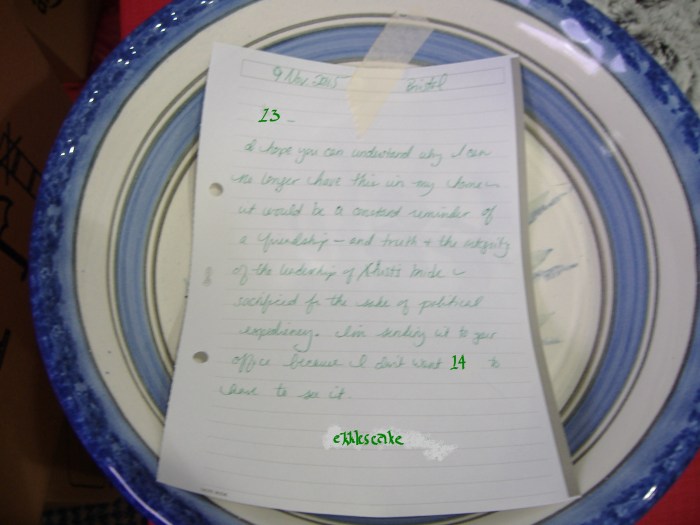
This was written September 16, and given to 13 via ekkles’ sister.  A contextual note: I never got a response to this. 13 claimed he was ready to discuss it while I was over in the US in October, but it didn’t happen while I was there, and after I’d left, though I tried numerous times to connect, I was ignored. I tried to verify email addresses through 14, but she didn’t reply either. Apparently, the friendship was over. I posted the wedding gift they gave my husband and me back to 13’s office in November 2015. I could no longer have it in my home.  See photo below.

13,

I don’t know what to say, or how to begin, but I’ll just let this all ‘spill out’. I can’t believe this has happened.

I look at pictures from my wedding, and see you in the pew, and with 14 at the reception; I see 14 and 15 at the organ and piano, 17 dancing during the ceilidh, 18 and me by the wedding cake. There’s another collection of photos from the first Thanksgiving my husband spent with us, all at your barn—14’s nephew was there too, that year, and read stories. My sister’s been very privileged to have gone on an Alabama trip with the girls; you and 14 had my husband and me over for a BBQ, while we stayed at your brother-in-law’s, on our honeymoon; my dad and sister went to Wisconsin for the graduation of one of your granddaughters earlier this summer; last week my sister had me pick up a little gift for another here in Bristol; 14 and 15 took my dad to some of his chemo appointments. Then there was your campaign a couple of years ago: my dad still has a t-shirt (did he ride in a truck with you in a parade or something while he was on chemo?), and my sister wrote a letter to the editor in your defense, after your opponent accused you of willfully withholding contact information on your campaign fliers. Finally, I don’t know how many times my husband and I have told the story about how we didn’t have a proof of address when we went into the county clerk’s to get our marriage license. You serendipitously came in while we were there, trying to figure out what to do, and you were so happy to vouch for us—we got our paperwork immediately.

How could it have come to this? I thought we all were friends.

With much sorrow and confusion,

ekkles”

Posted to the US on 9 November 2015:

dishreturnblogversion

The note reads: ’13–I hope you can understand why I can no longer have this in my home–it would be a constant reminder of a friendship–and truth and the integrity of the leadership of Christ’s bride–sacrificed for the sake of political expediency.  I’m sending it to your office because I don’t want 14 to have to see it.’

<—Exhibit E.                                                                     Exhibit G.—>

Exhibit E. My Reaction to 54’s Report & a Poem, Sept. 2015.

[Return to Table of Contents.]                                                       [Exhibit F.—>]

‘You shall not have in your bag two kinds of weights, a large and a small.  You shall not have in your house two kinds of measures, a large and a small.  A full and fair weight you shall have, a full and fair measure you shall have, that your days may be long in the land that the LORD your God is giving you.’   –Deut. 25:13-6.

I have not confirmed whether the text of the church coach’s ‘report’ on the state of the church is a matter of public record, and thus have opted not to post it at this time. Instead, I include a snapshot of my emotional state after reading it. This is not meant to be a representation of all that the report said, nor is the anger and frustration directed toward all members of A. Of course, I would claim that the report’s globalizing generalizations about the church were thoroughly irresponsible, though there was and is a not insignificant contingent who were playing the role of the malcontents among the Israelites in the wilderness.  What is just as problematic as the inflating of the numbers of the unhappy (attested to by council members) is the uncritical way in which their opinions are not only reported, but implicitly granted credibility and validity, and on which it was worth taking swift action (to ameliorate feelings? Or to seem to be acting to ameliorate them?) without investigation or even biblical reflection on the attitudes which produced them.

NB: When I use the term ‘congregation’ or ‘people’ in some places below, I am not referring to the actual congregation as whole, but to the ‘congregation’ as represented and described in the report.

4 September 2015

  • Where is Jesus? This could have been written for any secular organization with relationship issues.

  • Everything is the pastor’s fault. The congregation have no obligation, either to him, to God or to themselves.

  • They’re even found a way to blame PT for their apathy: ‘we don’t do anything—and it’s his fault! We don’t feel good, and it’s his fault!’ And back in February the church was described as a group wherein ‘nobody cares’, and as church that ‘doesn’t pray’. Again, now the congregation doesn’t have any weaknesses, bear any blame, or any areas which require some tending to and growth.

  • Using the word ‘discerning’ is ironic. And so is the use of the term ‘burnout’. They don’t know what burnout is. And they demand PT do more, more, more. Do they know what he does already?  [author’s note: the answer to that is ‘No’.  The Sundays following the suspension and termination saw skeletal bulletins; one Sunday, there hadn’t even been a worship order prepared!  A hand-written note was found in the sanctuary with a jotting of hymnal numbers; one, ‘How Great Thou Art’, had been sung the week before, *sigh*  People, if they thought about it, would have realized that neat, attractive, organized, tailored and varied orders of service didn’t just happen, 19 April 16]

  • The lack of Christian love, or even mere sympathy, should be devastating.

  • They don’t care about him. How he feels, how his circumstances have affected him, what he thinks about all of this. All these good Christian people don’t even feel the obligation to talk to him face to face.

  • Not only that, but it’s cruel to accuse someone of all these things without giving any examples either to apologize for or defend oneself against.

  • The letter shows the capitulation to the therapeutic culture—its vocabulary, its priorities, its loss of grip on reality, its way of assessing, framing, and addressing problems—that David Wells has talked about.

  • What is the truth? Where is God in all this?

  • And who gave the pastor a fair, uncontaminated hearing? Nobody.

  • It should be obvious to anyone with a sense of the spirits that this was all orchestrated by 13.

  • I sent it to myself so it could be opened via Kindle, but the thought of re-reading it makes me sick.

  • Turncoats, and inconsistent!

  • Who’s to blame for the fizzling out of the Care Group? What about the interaction with K*? What about Wisconsin?

  • How can someone be motivated to ‘step up his game’ or exert himself past his limits (already?) when all his previous efforts are ignored or disparaged? How is someone supposed to be motivated to visit people on their ‘home turf’, etc., (who does that anyway!?) when what he’s experienced from several is judgment, criticism (behind his back no less), and rejection, with no opportunity to respond or build bridges (plus just not being treated like a person who has feelings).

  • They (who?) complain about crying after messages. How can they possibly understand the anxiety, the doubts, the despair, the loneliness, of a being a pastor in this position and with Satan AND his own flock coming after him like this, and not giving him a moment’s peace? It’s unbelievable.

  • 13’s managed to turn PT into a stranger or an enemy. No one thinks of or remembers him as the person he or she knows. These aren’t the remarks and actions of friends or neighbors. People ought to have been encouraged to talk to the pastor themselves. Instead they’ve been encouraged to stew and to ‘combine forces’, churning their own pot instead of looking for mutually beneficial solutions and meetings of the minds.

  • Like DV*. JMM said the ‘report’ is ‘useless’. Certain denominational officers: screwing over pastors, one church at a time, since at least 2006.

  • It’s time for a reality check. Good Christians don’t do what people in that community do all the time and get away with it. You can’t assume validity of opinion just because someone ‘lives there’ or ‘goes to church there’! The area is full of crap Christians and crap worldviews [like a lot of places!].

  • What has embittered them all? The departure of God’s blessing in the form of His Spirit.

  • Why can’t you see that so much of what’s happening is run by and centered on 13? It’s plain as day! And everyone else is taken in by him because he strokes their egos and helps them shift blame away from themselves.

  • Deception, confusion, discord

  • Nothing in that report about how the pastor feels betrayed, let down, and unheard.

  • What were people doing before you came? Running everything without needing a pastor?

  • How could PT be controlling everything when he’s been ill?

  • Need to break that stronghold—he’s laughing at us!!! And 13 is taking the church down a road, a course, from whose consequences the church will never recover.

  • 13—kicking a man when he’s down, win at any cost. Why is he out to stick it to PT?

  • Used to be friends—54, doesn’t that strike you, trouble you?

  • Is this God-honoring behavior, worthy of lifetime church attendees?

  • Dear 19, I’ll cut to the chase. My dad is really depressed, and I’m very worried about his well-being and that of A. Did you ever get the email I wrote back in Jan/Feb? I fear I was very much in the right, and the situation is desperate. Please can you let me know if you ever got it and thought about it? I also noticed that people stopped responding to Care Group emails. Has it been allowed to fade out?

  • Pain? How cheap. No, there’s a difference of opinion. WHO IS RIGHT?

  • It’s not the way they think it is.

  • They’re deluded. They’re not as committed as they think—what about the small group sign-up? Teaching Sunday school? I came home from Christmas break and wrote a Xmas programme because no one else had time for it! DELUSIONAL!!

  • How can PT go on with the deck so stacked against him?

  • The deception is thick. Like black mud—sticking, oozing, binding, blinding.

  • This spirit is pitiless. And it drains all capacity for pity or tenderness in its carriers.

  • When we’re children, we’re disciplined for treating others badly. Our parents or teachers say, ‘How would you feel if someone said or did that to you?’ How could something so simple fall to the wayside? How could someone write a scathing email, receive a sincere, thoughtful apology back, and then not even acknowledge it? What kind of Christian behavior is that? And who is encouraging it? Who is causing the ‘pain’?

  • The ‘music’ plug serves 13 and his family. How nice.

  • Even people’s characters are being altered—they’re doing and saying things that are changing who they are as individuals and as Christians.

  • The job of the shepherd is to lead and teach the flock. The job of the flock is to follow and grow, and support the ministry if it’s God-honoring and biblical. It’s a two-way street. All I see is a list of demands on the shepherd, and unsupported, unexplained claims that the flock is being prevented from serving.  [author’s note: again, 14 in her phone conversation with ekkles said both that getting people plugged in ‘would help them to mature’, which was somehow linked to people’s apathy, but then also said that the pastor wouldn’t relinquish control; it was hard to know who was who, how these issues related to each other, and also, whether some forms of ministry are right for use as ‘on the job training’, 19 April 16]

  • About oversight & committees: what if what some people want to do is unbiblical? Or doesn’t honor God? You can’t assume anything about where these people are at. They’re not as knowledgeable and mature as they think they are, or are being told they are.

  • History lesson: This started in earnest with the series on the person and work of the HS. This teaching was passively rejected

    Update: 5 July 2017, Anniversary Treat! A pdf of 54’s original report with my comments embedded, for your reading pleasure!

  • >>report to Aetna Council w in-text comments<<

I sent this, along the letter to 54 sent 3 September last year which is posted in Appendix vi.  He has had 10 months and 2 days to reply.  I don’t expect to hear from him again.

  • A Poem:

Alas the church

It’s a wee little thing.

Been little for a while. Why so?

It can’t be…because of us, could it?

There is a man in charge. Sort of.

We don’t really want him to be. But we need him as

A figurehead at least.

Gives us something to look to, to point at—

In case of need for a scapegoat.

We want more responsibility. Ish.

Or gift opportunities, whatever those are.

And yet—I don’t want anything to be my fault…

Perhaps I was prevented from acting—

Yes, that’s it! He wouldn’t let me!

I remember—though—one time—maybe twice

He opened the floor. He asked us all on that committee—

For input; it was a project.

Somehow I—we—didn’t find anything.

Did he end up doing it himself? Must have done.

Wasn’t my call at the time.

And there has been a care group.

But not anymore.

He was leading it. And now it’s gone.

That’s probably his fault too!

No matter that no one answered the emails.

If he doesn’t know why this is happening,

Well, I suppose someone should tell him.

Me? Why me?

That would be a bit awkward.

It’s easier to put in my complaints with HR.

Anonymity and vaguery suit me well.

They say they’ll make him change.

That suits me too!

My church isn’t growing—blame the pastor.

My kid is breaking God’s law—blame God.

Memory fades so fast. But I don’t recall feeling this way

A year ago.

And then it was as if the whole meeting house

Sighed,

Breathed out all its breath and warmth

Seeping out through the windows and at the door-jambs.

And a dusky, gray murk settled on us all.

I may have asked in passing what I did.

I know someone must have done something!

It was like someone took the chocolate chips out of my cookie.

When I pray it’s so densely quiet that there’s no room for an echo.

The pastor, he must have done it! He’s up there!

The oppression!

What he says, the feeling of the place, makes me sad.

Holy Spirit? Who’s He?

I begin to remember now—some months ago

I got a phone call from an elder

He told me I was great, smart, talented and all—

A pleasant opener.

Then he pressed me a bit—seemed to know something I didn’t—

Wasn’t I unhappy, and weren’t these the reasons why?

Didn’t I deserve to be fed—my way?

I’m sure I already

Had these opinions before.

Well, maybe not so sure.

What’s that? Scripture? Oh, a photo.

I do remember. That’s me, us, at the picnic that summer.

Hrm, that was nice. What?

I’m knitting my brow?

It’s nothing. It’s just—I don’t know what I’m thinking.

The church is in a bad way.

Someone said something about demons? Who did?

I don’t know anything about that.

But…that picture. It’s true, it wasn’t always like this.

I do not have a short memory!

Oh, you remind me…I did say that, didn’t I?

Why shouldn’t he do more?

I guess that also is true.

I don’t know, I hadn’t thought about it. It was twice

In three years, wasn’t it?

Of course I’m a Christian! I’ve been here all my life.

He—well, he’s been running everything.

Won’t let anyone help. Sick?

Well, yes, I guess he was sick.

But he still had control?

Oh…I guess it’s my impression.

I guess.

Oversight? There’s the Bible again.

You keep bringing that up.

I just want it to feel like family.

Even if it’s a dysfunctional one.

But he wants us to be serious!

I don’t know.—I haven’t asked Him.

You think He’s got an opinion?

I—don’t listen. I just—

Ask for what I want, really. Doesn’t everyone?

You’re right. It sounds bad.

I’m sure he’s still to blame—

He’s the man in charge, though we don’t want him to be.

The elder will fix that.

He said he’d straighten him out, tell him what to do.

He said he’d make him do what I want…

Doesn’t sound good, does it?

But it’s little, and desolate, and I won’t have it be my fault!

You do talk about the Bible a lot.

I wonder…what do I really think?

Can it—can it be that—maybe we aren’t so great?

<—Exhibit D.                                                      Exhibit F.—>

Exhibit D. A few sundry points for context, August 2015.

[Return to Table of Contents.]                                                           [Exhibit E.—>]

‘So if you are offering your gift at the altar and there remember that your brother has something against you, leave your gift there before the altar and go.  First be reconciled to your brother, and then come and offer your gift.‘   –Matt. 5:23-4

‘Good sense makes one slow to anger,
    and it is his glory to overlook an offense.’    –Prov. 19:11

My dad and sister were supposed to make their very first trip to visit me and my husband in the UK in mid-August. After the event of the hand-written note, and some back-and-forth with 13 about, among other things, accurately handling Scripture, my dad tried to discuss their disagreements and what he described as 13’s ‘blindsiding’ (with criticisms, undermining remarks, unannounced sharing of the handwritten note with the rest of the council, in council meetings, before having discussed it with my dad) after a morning service on Sunday 2 August 2015. This did not go well; 13 did not want to go over any of the material, even to give explanation or examples of what he meant by the suggestions. My dad said 13 got markedly irritable, even snarky and antagonistic, making sarcastic comments about my dad thinking himself ‘brilliant’ while 13 ‘wasn’t’. My dad said that he told 13 more than once, ‘I feel like you’re not hearing me, 13. You’re just shutting me down.’ 13 apparently did not feel obligated to dialogue. What he expected of my dad, aside from just ‘doing it’ (?), was unclear. This, again, was someone whom I thought close to my dad (my dad thought he was his friend), an elder in a Christian church, a professional man in a high-profile public career, and much older than my dad. (I have my father’s permission to share his email describing this event; anyone who would like to read it can request it from me via the comments.)

Another event took place that is worth noting, though like the previous just described, the written communications regarding it are better briefly summed up. My dad was to be away for two Sundays while in the UK, and had secured pulpit supply. The first Sunday, the service was to be led and the sermon preached by a retired minister; one of the young men in the church was also going to give a presentation about his experience while doing missions in another region of the US. My dad got a call one evening before he and my sister left for the UK, from one of the men in the church. 13 had come up with a great idea: tell the retired pastor he wasn’t needed that Sunday morning (less than a week away), and just have the young man (neither a minister nor in training for the ministry) lead the whole service. 13 was apparently very enthusiastic about this. As far as the caller could tell, 13 didn’t care much about the aspects of professionalism or courtesy involved in cancelling a pulpit supply minister on such short notice, after it had been in his calendar for weeks, and after he had already likely begun his preparation. Also, my dad asked the caller, has the young man been asked if he wants to do this? The caller said he would get in touch with the young man. Perhaps not surprisingly, the young man was not entirely comfortable with this; someone in his wisdom had the idea to put the young man in touch with the visiting minister, so they could coordinate with each other about the service themselves. 13, who, it could be argued, had no business trying to arrange such things, was in this case ‘brought up short’. It is worth noting that the caller told my dad that he’d heard about this big idea (modern, vibrant, exciting, different, or something…), and figured my dad didn’t know. He didn’t want him to think this was being done ‘behind his back’, or at least, couldn’t let it pass without giving my dad warning. Of course it was being done behind his back—13, I am certain, had no intention of either asking or informing him about it, even though it had been my dad who secured the minister for pulpit supply in the first place.  This drama on the eve of our family visit, before my dad’s and sister’s first trip across the Atlantic, the cold and selfish machinations which no doubt continued in their absence, was aptly dubbed by 42: ‘cruel’.

Inevitably, such intrigues (and anxiety about them) cast a pall over our holiday. I shall include as part of this Exhibit a happy moment from our trip—overall ‘ruined’ by the agitators, as my dad said to my sister in the following months, and at a later date, I may include a sketch I drew while reflecting on one night while we were up in Scotland, my dad looking so utterly helpless as he wondered what was going on back home, with those whom he once trusted, now that he was away and they were free, we all feared, to scheme.

DSCF1019

<—Exhibit C.                                                                                   Exhibit E.—>

Exhibit C. ‘For the Record’, July 2015.

[Return to Table of Contents.]                                                          [Exhibit D.—>]

‘…it seemed good to me also, having followed all things closely for some time past, to write an orderly account for you, most excellent Theophilus…’   –Luke 1:3

I wrote this document in the summer, most of it following the events of 4th of July weekend. This was both for myself and for posterity, and tells of the recent events from my point of view, as I spoke and emailed with my dad often. I am glad in retrospect that I wrote so much at the time, before my memory had been cluttered by the messiness of the fall and winter. Again, I had become one of my dad’s confidantes, and the majority of this is from our correspondence. It may be alleged to be hearsay; I am happy to be corrected on any point of either presentation or interpretation. Again, I admit that is my take—I am sometimes suggesting my conclusions, and sometimes I am sarcastic, but I do admit my biases (devotion, religious or otherwise, requires bias). However, I again offer as many of the facts as possible, so you can judge for yourself, and feel free to speak to those on the other side. And of course, my admission of subjectivity is more than plenty of others in this drama are willing to admit about their involvement, or the rot they produced, on which so much hinged, while this is me telling my story, with no power to change anything.

author’s portrait of Luke, Burney MS.20, f.142v.

This document is unaltered from the time I last edited it, in August 2015, save for four things: a note added in ch.32, hyphens added in ch.34, the word ‘not’ removed from ch.39, and all names changed to numbers or letters.

FOR THE RECORD.

  1. I won’t be the first one to observe that evil prospers while good suffers. The Psalms and Wisdom Literature tell us so, plenty of times. And so often in a silent battle, the good slinks away with nary a word, nary a complaint, while evil sings its own triumph. No one remains to tell the truth, to level a charge. Evil gets away with so much because good is too embarrassed to say anything. In many cases, good is afraid it will be blamed, or shamed—told it is making too big a deal out of something, told it should have done something differently… any number of things to excuse failure to execute justice.
  2. This time is going to be different. There will be a record, the story will exist, in writing, as a history, and those who ignore it will bear the consequences of their actions in willful ignorance. I don’t claim independence, or lack of bias, no—but here it is, so judge for yourself.
  3. I am a Christian and an academic. What I want most in my Christian walk is to please God; the height of my worldly ambition is to be a great writer and an honest scholar. My bread and butter is research, so what you will find here is a compilation of a great deal of evidence, and of different forms—timelines, correspondence, autobiographical passages, and narrative, perhaps even some poetry. Some evidence must of necessity be omitted or streamlined—complete records of correspondences of involved parties are, unelegant though it sounds, archived in a gmail folder called ‘A. saga’.
  4. A few points must first be clarified before I begin the narrative proper. First, it is a fact that man is born to trouble, and as much as the sparks fly upward, affliction follows the righteous. The experience of the church and pastor recorded here is not unique; many pastors have suffered this type of affliction, and this pastor has suffered it more than once. These events have not occurred in a biographical vacuum, nor a locational one: the pastor has a history, the community is a context. Both must be kept in mind as you read.
  5. The biographical information will be scattered throughout the record; it will suffice to give a bit of information about the community in which the events take place here. The community, as much as any other rural Midwestern American settlement originating in the late 1800s, is for purposes of description, hard-working, conservative in values, tight-knit, family-oriented, and Christian. It is overwhelmingly ethnically Dutch; the denominational disposition of the churches in the area reflect this. The Christianity, however, is determined more by the local culture’s tradition rather than by personal conviction. This is borne out by the fact that in the area’s recent history, young people leave the church, never to return—many of these are young people who have been educated in the local Christian school, yet are abjectly ignorant of basic tenets of the Christian faith (not very different from their parents, it turns out). They sit under the preaching of the word week in and week out for years, and yet none of the parents can explain why they live lives of rebellion against God. It is a mystery.
  6. Among the adults there are problems as well. I am an outsider to the community—I was born in the southwest side of the state, in a big city, and grew up there and in small towns in the southern part of the state. So, I have no inkling of what happened between these people in the past. Tight-knit the area is, but there are deep rifts between families and branches of families, of whom representatives of both sides often continue to attend the same church, sitting on opposite sides of the aisle, and not speaking to each other, though the fellowship is less than 100 people. No one will speak of ‘it’ or ‘them’, so it is impossible to know what the original matter was. It perhaps wouldn’t be surprising that some of those involved no longer remember it, but act as if it were still a living quarrel. Unity and harmony of the body has not been stressed enough to motivate the parties to make things right.
  7. However, out and about in the community, you will not find a nicer, more welcoming people. They work hard, and should a neighboring farm have a disaster, like a barn burning down, they rally to help. They are excited to meet new people, and when we first came to the area, there was an outpouring of enthusiasm and support for new pastors when they took calls to the neighborhood churches. People brought produce from their gardens, made pies and baked cookies, sent fruit and gift boxes at Christmas, had the pastor’s family over for Thanksgiving. They really knew how to look after the ‘vicar’.
  8. After ministering in such an area for six years, with a not unusual number of kerfuffles (which may be mentioned in the story later), the pastor was looking to take the church to the next level, and began an evening series on Seeking the Spirit, with a goal of introducing the members to spiritual gifts, and should the Lord will, begin to tap into the gifts in that local body that would lead to a deeper experience of the Holy Spirit in the church and grow them. Dates and topics of this series will be appended to the record. Some months into this series, after reviewing a history of the charismatic movement, the charismata in church history, and finally the lists in scripture, looking at each gift one by one, an older couple in the church made a very public protest, disrupting an evening service by insisting that what the pastor was teaching wasn’t ‘reformed’, and that he was ‘stretching’ the word of God (this was after three other events which are mentioned in the timeline). The pastor sought to meet with them two-on-one to discuss the issue, but they made it plain that there was ‘nothing to talk about’. They knew what they believed, didn’t need the pastor to explain himself, and that was the end of it. The following Sunday morning, two of the elders met with this couple to address their behavior—they said they wouldn’t be back. Some weeks later, this couple sent a letter to the church council, detailing the pastor’s alleged heresies, asserting his dishonesty, and demanding the council seek to have him defrocked. They let the council know in this letter that they had appealed to the denominational authorities themselves. In a reply letter, the council ‘honored their request’ to render their church membership inactive, while disagreeing with what they said about the pastor and his teaching; the tone of the council’s letter was hardly chastening, and did not address what the pastor believed amounted to slander, as they [the leavers] had written that he was ‘not honest’. It was all the pastor could hope for; not all of the elders had read the letter, and one who had not[,] scoffed at the idea of it’s being at the level of slander. And no-one was willing to call them on their behavior outright, for fear it would do greater harm to a small church which was teetering ‘on the edge’. The matter thereafter was dropped, and in the minds of all but the pastor, and his adult daughter who had been present for the evening service, it was forgotten.
  1. This all came to a head in October 2014. Around Thanksgiving of that year, the pastor began to receive unsolicited comments and advice about his preaching topics, attitude, and music choices, from one of the elders, 13 (the one who hadn’t read the allegedly slanderous letter) and his wife, 14. It was actually during a Thanksgiving get-together at their house that 14 asked the pastor if he would change what he was doing, because the people needed ‘joy’ and ‘comfort’. It came out later that 14’s reading of the situation was that the pastor was ‘grieving’ over the situation with his wife, who had left several years before. It hadn’t seemed to occur to her that a much more recent trauma had taken its toll.
  2. In the pastor’s mind, the joy and comfort she, and later her husband, were seeking, were vague. Or, perhaps the better way to phrase it is, he didn’t know why they needed to be made to feel joy and comfort, or how he would have been able to that, if he could. Something seemed to have changed recently, and it seemed that they believed he had the power or responsibility to counter it by preaching ‘joy’ and ‘comfort’, though at the time, and even afterwards, when it had become a mantra, he didn’t really know what it meant, or what such preaching would sound like. And he didn’t know how what he had been preaching lately was joyless or comfortless. Appended are the dates and titles of morning sermons from this period; the pastor was simply working through the gospel of Matthew. The reader can consider this for himself.
  3. The annual congregational meeting took place around that time. One of the elders, contrary to the church order, ‘opened the floor’ for ‘any other business’. A member of the congregation, without consulting the council and without any warning, came forward and voiced her concerns that people weren’t getting involved, or weren’t committed enough. She mentioned something about doing a church survey. In response to what she’d said, a former elder stood up and said he appreciated all that, and that he knew there were issues, and that he and his wife had thought about leaving. [there is a past history with this particular parishioner which may be included in an appendix] The pastor was taken aback. The potential for harm in such willy-nilly handling seemed to be completely beyond both the elder who opened the floor, and the parishioner who voiced her concerns and complaints, valid though they were [author’s note: mark the fact that the parishioner pointed to other people’s lack of involvement as the church’s main problem; less than a year later no one in the congregation bore any responsibility for the church’s situation, 19 April 2016]. And the response from the other parishioner in the pews was not upbuilding to the body, but rather destructive. The damage had been done, but in God’s providence the meeting hadn’t spun totally out of control.
  4. Christmas came and went, and there were a few incidents worth mentioning. On two different occasions, one of them back at Thanksgiving [2014], the pastor had selected certain songs for the morning worship, and 14, regularly involved in the music as the church’s organist, asked the pastor to change them. They were sad or people didn’t know them—one of the songs he had chosen was labelled a ‘dirge’ by 13. Something unconnected with the pastor, but in this vein, also happened just around Christmas. The pastor’s daughter was assigned to do the worship order for a particular service, and had put a great deal of prayer and thought into the songs she chose. One she found was not available in the church’s hymnals, and after corresponding with a Lutheran friend in Washington state, she acquired both words and music for what she thought was an ideal, evocative hymn for the service’s theme. Without telling her, someone somewhere dropped the song from the worship order, because ‘nobody knew it’. She was considerably frustrated. [author’s note: I don’t mean to spoon-feed, but, ‘Double standard much?’, 19 April 2016]
  5. Council elections were on the roster for the new year, and 13 graduated to VP of the council. 13 and his wife 14 had to this point been some of the pastor’s most significant supporters, encouragers, even friends. They had the pastor’s family over quite regularly in previous years, and with their daughter and her family, who were also members at A.. If anyone could have been described as friends of, and close to, the pastor and his daughters, this extended family was it. 14 and her daughter had done the music for the wedding of the other daughter of the pastor, and both 13 and 14 had been the most welcoming of the pastor’s son-in-law. 14’s sister [author’s note: this ought to be amended to ‘brother & sister-in-law’, 19 April 16] offered her home to the young couple for part of their honeymoon, and 13 and 14 never missed an opportunity to visit with the pastor’s daughter and her husband when they were in the area—they always had them over for a meal.  Until their Christmas trip of 2014, when 13 never even spoke to this daughter. They had had a loss in the family, 14’s mother, so it was no surprise that they couldn’t host them. But the daughter was in attendance at the funeral, and 13 was the only member of the family who didn’t greet her. She spoke with 14, with 14’s daughters, with her [brother and sister-in-law]—she was in the hall a long time, and was unmet by 13. She didn’t think it strange until later.
  6. At any rate, 13 was now VP of the council. The voiced desire for more joy, for more comfort in the preaching, began to morph into outright criticism of the pastor’s performance, at first, only in one-on-one conversations. 13 told the pastor what had improved, what was closer to what they needed. And, the survey suggested by the parishioner, 28, back in the congregational meeting seemed to have been undertaken by her, with no consultation of the council, no parameters set for its focus, how it would be carried out, and what would be done with it once the results were in. There was lack of oversight, and lack of clear purpose. And when the survey was finished, it was stunning. She had pieced it together from samples she found online, and the questions and overall thrust of the survey were ominous—more than anything else, it invited negative feedback and criticism of the leadership and pastor. There was nothing to evoke self-reflection or introspection, nothing about the parishioner’s own role and responsibilities in the church or his own spiritual growth, and, strangely, no space for positive feedback. There was also no mention of prayer life, either the individual’s or the churches, nor any way to rank the maturity of the respondents. Was the opinion of the person who only came once a month to count as much as that of the most regular attender? There was no doubt she meant well, and had spent considerable time and effort in creating the survey. But it had had no direction, and the result was that it would do nothing to reveal the spiritual state of the church beneath the surface, which had been suffering since the débâcle with the couple who had left the previous autumn. In short: it was a mistake.
  7. When the pastor objected to the survey, 13 was flustered—he had wanted to take action, to move forward, get people joyful and enthusiastic, and the survey had been seen as a potential catalyst. When the pastor suggested slowing down, and getting denominational help to take inventory, 13 said he wasn’t going to ‘wait until May’ (this was now sometime in January or February), for what, it wasn’t exactly clear. For the survey, for change..? In response to this, 28’s husband, a deacon on the council, said, ‘If it takes that long, my wife is gone.’ Imagine the sinking of the pastor’s heart in that moment!
  8. It was around Valentine ’s Day that the pastor’s married daughter, living abroad, received a desperate email from 14, looking for feedback, prayer support, because A.’s situation was dire. The daughter called her and they talked awhile. 14 said that there was a lack of joy and comfort, and she though the pastor had been grieving, and that’s what everyone {in the church} was feeling, and that she had tried to get him away from the ‘sin sermons’ and ‘the Matthew stuff’. The daughter was stunned to hear this from an older Christian. For one thing, she’d been listening to the recordings of the pastor’s messages for the past several months, and had no idea what the ‘sin sermons’ were. And the second phrase, and the derisive tone in which it was said, took her aback. This woman didn’t seem to realize she was saying such a thing about one of the Lord’s gospels, much less the Word of God. She also said ‘13 has been trying to help him’, which explained what he believed about his own behavior in telling the pastor what he ought to do and change. At the same time, she was saying that she and 13 had ‘learned so much’ from the pastor’s teaching, but that now that he’d equipped the flock, he wasn’t letting anyone else do anything. That he was afraid to let go of some control. The daughter was stumped.
  9. 14 had mentioned her own daughter, 15, and her frustrations with the pastor. Not many days before, the worship committee, of which 15 was a member, had met, and it had been a strange experience. The pastor described it as a ‘weird atmosphere’. 15 and another woman on the committee, R, lamented, ‘what are we going to do?’. There seemed to be an eagerness to do something new and different; someone asked if they could watch a movie on a Sunday night rather than have a service. 15 had in her notebook a sticky note that she wanted to share—it was 3 points, all things she’d heard ‘people’ say: 1. Sunday nights are tedious 2. I wish I wanted to come to church 3. Where’s the joy? Again, imagine being the one on the receiving end of such faceless, nameless, contextless remarks. Not long after, both 15 and R announced, via 13 in a council meeting, that they were ‘retiring’ from the committee.
  10. At any rate, 14 was now telling the pastor’s daughter what 15 had been telling her—that the pastor didn’t welcome new ideas or let anybody do anything. When the daughter talked to the pastor about this, he said, ‘That doesn’t seem right. Are there any examples?’ (Note: cf. passage 12) He also mentioned occasions when he had very deliberately left the door open for others, especially for readings and themes at Christmas and Easter, multiple times—no-one ever took the initiative, and so he ended up doing them all himself. The older daughter, who wasn’t on the worship committee, did the Christmas candlelight programme herself one year [while home from college over the holiday break].
  11. The daughter later had one other communication with 14, via email, where 14 said she thought, again, that the pastor was doing too much, that he needed to trust people, and that letting them get involved would help them to mature. She also said she thought the church was sick, and that no-one ever sent cards to or visited shut-ins. She made some good points, and others that raised questions. The daughter (whom we’ll call A* [ekkles] from now on) delayed in replying, drafting answers and then waiting to send them. Sometime in May 2015 the pastor passed on that 14 had mentioned not hearing from ekkles in a while; ekkles then wrote two emails, but didn’t receive a reply.
  12. The Spring Sundays came and went, with 13 offering more ‘constructive criticism’ (bits of these conversations will be appended for reference), and proffering opinions at odds or contradictory to those voiced by the pastor in the youth Sunday school co-taught by them. Some such conversations are noted in the timeline. During these classes, the pastor began to note 13’s penchant for flattering and disproportionately praising and complimenting people (people not the pastor, it must be emphasized). Once he noticed it, it was hard to [stop] keeping track of it.
  13. After some awkward weeks of this, 15’s daughter 17, a high-school senior, stopped attending Sunday School. Other students were absent more and more often, and without word of notice to the pastor, or sometimes even to 13. But when the pastor asked 17 why she wasn’t attending anymore, she explained that she preferred to stay in the fellowship hall and ‘have fellowship’. Whether there was more going on than this, is not for the reader [that is, author] to say; but her parents, having permitted this decision, evidently did not think she should let the instructor know about it. The bigger issue raised is the meaning of fellowship, to which we will return later. Suffice it to say that, while ‘chilling’ in the fellowship hall with these folks is nice, sometimes very nice indeed, rarely does discussion ever go beyond the weather, community events, school, and farming [at least in the author’s experience].
  14. In April, the pastor was blessed enough to be able to attend a Dunamis conference. He’d been invited by the denominational [state] prayer coordinator, with whom he’d met in [city of denominational headquarters], with a group, to pray for A. The Lord spoke through the people with whom he prayed, both that day in [the city prayer meeting] and at Dunamis. He had several special experiences at the conference, including a particular confirmation of his calling, and that he heard from God. He waited for opportunities to share about this experience with the council, with the Care Group, but the time never seemed right, or, he admitted, he lacked the courage to bring it up when there was an opportunity. He feared being laughed at or dismissed, or treated like he was crazy for claiming to have such experiences of the Holy Spirit. He and a close friend, who’d been a major support to him, mostly because she herself was gifted in discernment and willing to be led by the Spirit, had tried to share about their experiences and perspectives in the relative safety of the Care Group before—no-one else in the room knew how to take it, and all seemed afraid [?] to show even curiosity. The pastor’s older daughter had once appealed to one of the care group members to get in touch to talk about her own spiritual experiences—and never received a reply [as of the writing of this document].
  15. Sometime in early spring, the pastor came up from the basement to the narthex, and found that a long table, which had for years sat just outside the doorway to the sanctuary, had been moved, and was now up against the wall just inside the west-facing doors going out the road in front of the church. It had been in its previous position a long time, with bulletins, notices, and other paperwork on it. Now this it was by the outside door, whenever the door was opened, the papers atop it would fly all over the narthex. But the question was, what was it doing there? Not long after, during prayer time in a council meeting, 13 thanked the Lord for new ideas, and perhaps opportunities or willingness to embrace change and what good that can be, just like moving that table into the narthex. The pastor was puzzled.
  16. It wasn’t long before it became clear. Some Sunday shortly after, the pastor was in the fellowship hall, and saw one of the women walking into the fellowship hall with a large coffee pot, from the sanctuary, and, he realized, from the narthex. They had started serving coffee in the front of the church, using that table, before the service. And he had never known about it. Not that it should have been a big deal, really, but, why? And why had the gentle breaking of the news come as a thanksgiving prayer for the option of moving furniture? [author’s note: bizarre! 19 April 16] The pastor never said anything, but there seemed to be several possible reasons that came down the pike—as a welcoming device before the service, as a second option for people after the service, who don’t want to go into the fellowship hall…since to date there has not yet been a conversation between the pastor and the group who led the coffee initiative or ‘coup’, or between the council and them, the ultimate purpose remains a mystery. Some weeks into the effort the pastor’s younger daughter was obviously bothered by the consumption of coffee in the sanctuary, for which purpose [perhaps one among several?] it turned out the coffee was being brewed, and had a conversation with a friend in the pew about [it]—the friend was pro-coffee in worship, and said that it was to ‘make it more fellowshippy’. Such raises questions about the nature of sacred space, separateness, worship, and fellowship, as well as appearances v. reality, cosmetic changes to  [address] spiritual deficiencies, etc. [author’s note: others besides the pastor’s daughter(s) have since expressed unease or objection to what they see as, among other things, irreverence, in having coffee in the sanctuary during a service; the author doesn’t believe that these people’s feelings or convictions were ever considered, as if it was impossible that anyone wouldn’t agree that it was a good idea, 19 April 16]
  17. At this point, it may be worth noting that, while complaints were voiced in more than one quarter that the pastor never ‘let anyone do anything’, people didn’t seem to have a problem with keeping him out of the loop or not ‘involving him’. And since it seemed to be assumed that his opinion, or that of the council as a body, didn’t matter when trying ‘new things’, why should anyone have been afraid that he would quash anyone’s efforts? It didn’t make any sense.
  18. In the meantime, the pastor had called in men from the denomination to help the church self-assess, set a direction, get an official line of communication on making changes (this was in lieu of or as a prelude to doing something like the survey). The men who came to the meeting with the council were 54 and N. 13 talked more than anyone else that night, and he evidently thought he had a lot worth saying. Among things he felt compelled to share were further criticisms of the pastor that had not been made previously known to the pastor himself, and as a result, to have his performance derided in front of the council AND in front of the official strangers was an incredible experience. It sent him reeling, and in the moment, put him in a very awkward and undermined position. This from and by a friend, whom the pastor had trusted. 13 did have time for positive feedback as well—‘everyone says the music is great, that’s a draw’. A consolation to him, no doubt, since his family members are major contributors to the church’s music.
  19. While the survey had been put on hold, 13, with one of the deacons in tow, had taken it upon himself to conduct his own survey, visiting members of the congregation to ask how things were going. At one point, there had been posted a council visit sign-up sheet in the narthex. It was posted for 3 or 4 weeks; no one signed up. One of the other elders remarked, at the end of the meeting with 54 and N, that he wasn’t going to visit anyone who didn’t want to be visited. 13 was not dissuaded, and apparently continued to arrange meetings when it had been evident that many in the congregation were not interested—it had to be done. He was very near to retiring by this time, and did retire in April 2015.
  20. In late 2014 there had been some sort of skirmish in the county seat, between 13 and someone else. It had apparently caused 13 a great deal of stress, and in February 2014, when 14 spoke to A, much of the joy and comfort they wanted was in part because of this stress. She also said she felt let down by the church because ‘nobody cared’ what 13 was going through, and how could the pastor be supportive or know what was going on with 13 when he didn’t read the newspaper? She really seemed to think that this indicated a lack of interest in the lives of those in the community, or that it must lead to ignorance about it. One might ask why a pastor, if he has been close to a parishioner, must be expected to read about that parishioner’s hardship in the newspaper rather than just talking to him about it. Very few sheep in a flock are going to be mentioned in the newspaper, and even what was in the paper about 13 were blurbs—hardly enough to get a handle on what was going on, or why it would have caused such stress. At any rate, he had made an effort in his last year as prosecutor to get something changed, and fought for it; the attorney general of the state of Michigan decided against him. At one point, it was said that he was going to appeal. All around the time of his retirement.
  21. In May 2015, the issue with the older couple who had left over the spiritual gifts series returned to the fore—they had asked for transfer of their membership to the sister church down the road, P—. The pastor did not feel it was right to simply forward their membership without addressing some of the outstanding issues, and he did take the opportunity at one point to say that the church had suffered the consequences of not doing the right thing when this couple were causing division and confusion. The council decided to forward their membership to P—-, but only after informing P—- of the history they had at A.. Again, it was the best that could be hoped for. And though people were reminded of what had happened, no-one yet understood the significance of what was a watershed event—it was a test of A., both how they handled the insurrection, and how they responded to the teaching about the Holy Spirit. And they didn’t pass.
  22. 13 shared a devotion at the council meeting after that on which the ‘event’ was discussed, something put out by Moody—but not the devotional reading for the date of the meeting, which was in the first week of June, but that assigned for the 24 June. The text was a passage in Job, and the thrust of the Moody reading and application was that Christians are not to call people to repentance. God is to do that. One conclusion quickly drawn after the recent history is that the pastor needed to know that he’s not supposed to call people to repentance—which he had apparently done when addressing the couple who had gone on to P—-. The pastor, who had not had a devotional reading planned, responded by reading a passage out of 1 Cor. 5. One of the deacons reacted with, ‘Why are you reading a passage about sexual immorality?’ No comment…
  23. In June, the pastor drove with his younger daughter to Wisconsin to attend the commencement of one of 13’s granddaughters. He was working on the worship order for the following Sunday, the second Sunday of the month, on which he would not be preaching. He contacted 28, who was supposed to be arranging the separate song service for before the start of the main service on the Thursday; by Friday, he’d had no reply. Come Saturday, there was a correspondence—28 said she was going to do it, but that she usually did the third Sunday of the month. The pastor wrote back to confirm, but reminded her that she had actually switched to doing the second Sunday back in May 2014. Her reply was, ‘Okay.’ That Sunday morning at A., in the fellowship hall, the pastor approached her in the company of some of the other women to talk about the schedule and make sure they were on the same page, see if she actually remembered the change—the only response was something to the effect of, ‘Whatever you say’ or ‘If you say so’. The pastor readily confirmed to himself he wasn’t crazy—the arrangement for song service leaders is a matter of record, on the bulletins, in emails. It had nothing to do with his ‘say-so’.
  24. In the meantime, the Care Group seemed to have faded away—nobody cared anymore, to reply to the pastor’s emails, or even to 28’s, when she offered to get it back off the ground with a bonfire [though the pastor himself did reply]. Sunday evening attendance by some of the most committed members had become sporadic; the attitudes of these committed members during services was different. Detached. And discontent seemed to be growing, but no-one was talking to the pastor about it. It seemed, if anyone was talking about it, it was to 13, and he would pass it on to the pastor, but more and more often in council meetings, without fore-warning, rather than in private. The pastor had tried to arrange a meeting to discuss issues with 13 back in the early Spring, but for various reasons, it kept getting postponed. Now, in early July, there still had been no meeting [see Exhibits D. and L.–in the latter 13’s claims about how ‘the pastor wouldn’t talk to him’ is patently false, 19 April 16]—and Dunamis had never been shared, nor had the pastor’s conviction that the church was neck-deep in demonic interference.
  25. The pastor’s concerns had of course grown in the interim, and he decided, in his next attempt to reconnect with 54, to let him know about the potential issues with 13. He emailed 25 June 2015. He heard nothing for some days, and sent a follow-up: when he finally got a reply from 54, 54 explained that he had been busy, but that he anticipated being in the area soon, and looked forward to discussing 13’s ‘recommendations’. The pastor didn’t know whether this simply meant what they had all discussed in the initial meeting, or more, but didn’t think much of it. His older daughter, in contrast, reacted with, ‘What is that all about?’
  26. Sunday 5 July. 13 approached the pastor with a handwritten-note, appended to the record (Exhibit B.). He said as he passed it off that they were suggestions from people in the congregation—that the pastor should just read it and think about, and that 13 ‘didn’t want to argue about it’. At least he had the decency to wait until after the morning service. Apparently he believed it to be fellowship-hall-appropriate. That same day, the pastor learned from one of the men who handled sound that 13 had asked for DVDs of recent sermons. Of course, the sound men didn’t have them; the pastor would take them home to put them on his computer and make mp3s to send to his older daughter. The sound man told 13 to ask the pastor, he’d have them. The pastor had not heard from 13 about this.
  27. That morning, 19, who’d been assigned the song service, wrote to the pastor, seemingly very angry. He had made adjustments to her arrangements, and she wanted to know why (the simple facts were that it was a load of hymns over the song and main services, and he took out one of hers, and one of his own, because he thought it was just too much). It didn’t occur to him that she’d be so offended. She wasn’t going to be there as she was travelling with her family, and another parishioner was leading it in her stead. She’d sent the email, explaining how much work and thought she put into the song service, and asserted that the pastor was ‘overstepping’ and ‘taking over something someone is willing to do’, and that the pastor needed to encourage people to lead and use their gifts, and he needed to understand that some people in the congregation are ‘capable’. ekkles, the pastor’s older daughter, heard about this email—the initial question and explanation, she could accept, sounded like 19. The ‘instruction’ and ‘admonition’ did not. The really strange part was the fact that 19 knew about it at all (perhaps through her mother, whom she said had chosen the songs with her and was playing piano that morning), thought about it enough to get upset, and thought it was necessary to inform the pastor about all these aspects and implications of what he’d done. And… this little event seemed to have made it to the very top of 13’s hand-written list. How? What sorts of phone calls were being made on Saturday? [author’s note: it occurs to ekkles that 28 & 19 were talking to each about this event and that described in ch.31… Were people really stewing about such things, and going to 13 demanding something ‘be done’? 19 April 16]
  28. At any rate, it was a double- or even triple-whammy weekend. Putting the email and the note together, daughter ekkles was eerily reminded of all that 14 had said, and what 13 had been saying. Either they were right, and everyone they’d spoken to, or whose thoughts 13 was reporting, agreed with them; or, they were wrong, and in the end it was simply their opinions that were represented in the note (though also in the email—19, it is the conviction of the writer, had been influenced). Wherever 13’s sentiments weren’t already growing, he planted them. It is my adduction that these mass diagnoses of the problem—the pastor, his personality, and his preaching—did not exist before 13 took it upon himself to make it so [author’s note: of course, some had had it in for him for a long time; these aren’t the people being discussed.  The people at the fore of the record are those who had in the past been supportive of the pastor and knew him well, 19 April 16]. It is very convenient that at the end of his self-conducted survey, the very wording by which he is representing the whole church (without express sanction or knowledge of the council) matches exactly what he and 14 have/had been saying all along. It is both convenient, and sick.
  29. 6 July 2015. The pastor replied to 19’s email, with both an apology, and an explanation for his decision. He didn’t mean to cause offense, or to negate her efforts. He spoke with ekkles, with his fellow pastor 44, and wrote to his friend J.
  30. 7 July 2015. The pastor decided, after advice from 44 (contrary to J & ekkles’s advice) to go ahead the council meeting scheduled for that night. He spent several hours on the phone and in prayer with ekkles. It was the second time in ekkles’ life that he’d been driven to tears in her ‘presence’, though over the phone. They received a word from the Lord (some of which was committed to writing at the time). They were encouraged to ask for a sign—the pastor asked that one of the elders might have a tangible experience of the Holy Spirit. The pastor decided he would write to 13, asking him not to bring up the note at the council meeting, and not to offer criticism, as it was undermining and hurtful; he also mentioned that they had yet to have a follow-up meeting between just the two of them. He sent this email to daughter ekkles and to his son-in-law, who read it and offered suggestions, then sent it with a prayer.
  31.  ekkles tossed and turned until after 2am her time, during which the council meeting took place. She got an update from the pastor the next morning: 13 spent a great deal of the meeting, certainly being positive, flattering everyone at the table every which way from Sunday. Everyone including the pastor, though the pastor himself, at this point, was not to be won over by such blandishments. It begs the question—was it strategic? was he trying to get people in his pocket? Did 13 try to make people want to be on his good side? It was a projection of power. He also belabored a point about getting more people involved, on committees, in efforts, making sure every committee had a council member on it, etc., because people were eager to get involved, were talented, and just needed to be asked. Apparently he’d had a different experience from the pastor. Was it true that people were eager to be involved? (cf. passages 15, 17) And it can’t be argued that they really are committed, but are confounded, because no-one ever approached the pastor himself with their issues, concerns, or accusations—there had never been a conversation [author’s note: of course, 19 had at least sent an email, but when the pastor tried to interact with it, and even apologized, she didn’t respond, so apparently the point was not to have a dialogue, 19 April 16], so how in good conscience, or even rationality, could people claim they were wanting to be involved, yet quitting or threatening to quit without even talking about it, and without talking to the pastor directly? It was making it very hard to know what to believe, or even know what people were really thinking—everything was coming at the pastor third-hand, and in odd contexts, without opportunity to follow up or ask for clarification. Also, would ‘involvement’ in ‘activities’ amount to more than just an illusory addressing of the problem? Was it really just a question of being busy?
  32. Finally, at this point, the pastor learned something more about how deeply his trust had been violated. On 25 June, the day he had written to 54, and thereafter not received a response, 54 had met with 13 at 13’s house. End-run? Pre-emptive strike? How else does one categorize the way in which it appears this elder and friend had gone behind the back of the pastor to talk to the denominational rep whom the pastor had brought in on his own initiative? It seemed evidence of strategy, and a game, and this was 13’s latest play.

<—Exhibit B.                                                                                   Exhibit D.—>

Exhibit B. 13 Writes a Note, 5 July 2015.

[Return to Table of Contents.]                                                        [Exhibit C.—>]

‘Then Absalom would say, “Oh that I were judge in the land!  Then every man with a dispute or cause might come to me, and I would give him justice.”‘   –2 Sam. 15:4

A handwritten-note pressed into my dad’s hand on Sunday 5 July 2015 by elder 13, with a comment to the effect of, ‘Just read it, I don’t want to argue about it.’ This was after the morning service in the fellowship hall. On the same day, my dad received an angry email from an offended worship leader; I know he spent a lot of time writing an apology to this person. To date I don’t believe he ever received acknowledgement of his request for forgiveness. I think it is clear that the offended worship leader went to 13 before broaching the subject with my dad. I respond to the rest of the points below. I have represented the punctuation as accurately as possible; the scan doesn’t always make mechanics clear.  The scan is included below the commentary.

Pastor T Some Suggestions 7/5/15

1. Don’t change, rearrange-alter song service leaders [sic] preparation. They feel like their effort has been disrespected.

2. Be more engaged in lives of parishioners & in community—be at functions—read the paper—have contacts—go to events—ie spend less time on internet.

3. Seek broader participation of your members—listen to them, act so they think their input is being integrated in direction of church

4. be less professoriale [sic] more pastoral. Feed the sheep. Comfort them w/ messages, their lives are difficult, encourage them. (illegible)

5. Have messages reflect joy in Christian life. We can live triumphantly in Jesus. They need to hear more than what seems like a continual call to repent!

Thanks, 13

Point 1. I’ve already made some remarks above; given how rarely my dad ever did make a change to the order of a song service, this is an odd item to have on a list which, I assume, purports to be representative of the major concerns of a majority of the church, and it certainly implies that this is a chronic problem. At the time, my dad went through his email records and was able to find only two occasions on which he changed an order or ommitted a song (for which he likely would have had an explanation—these weren’t power plays).  2 occasions in over 7 years.

2. This I found very odd indeed, as my dad and sister had only two weeks before driven and taken the ferry over to Wisconsin to attend the graduation ceremony of 13’s granddaughter. It would have been nice to have examples of things which he hadn’t attended, since I could think of the many community events to which I’d accompanied him (including soup suppers, the local youth show, the ‘Christian school’ concerts, graduation ceremonies and open houses, Booster club auctions…). The ‘suggestion’ to ‘read the paper’ makes me narrow my eyes, as this is, I believe, a pet peeve of 13; those aware of this point will draw what conclusions they may (how many parishioners and their experiences will be featured in the local paper?). If I want my pastor involved in my life, or to know what’s going on, I tell him. I know he has a job and a life and a family, and is not clairvoyant. Since I’m not in the Bristol Post regularly, that’s the only other way he would know I’m going through something without my telling him. I suppose a story could get around, but I won’t hold it against him if he doesn’t hear it and approach me first. If I need counsel, I let him know so he can make time for me. But that’s just my experience, I suppose. The remark about the internet I found very condescending at the time, though a few other issues arise—how does 13 know how much time my dad spent on the internet? And, my dad at the time wondered if such a comment was precipitated by his forwarding of a blog post by John MacArthur to the council. Apparently he ought not to have been wasting the time of those who are supposed to be equipped to teach the flock by drawing their attention to valuable outside Christian resources.

3. It is hard to know what this is about without context or examples of who ‘doesn’t feel integrated’. It’s also weird because only a few months before, I was speaking on the phone with 13’s wife, and she stated very succinctly, ‘ekkles, people just don’t care.’ She also said, ‘Maybe this isn’t a praying church.’ Are 13 and his wife describing the same people? This point in the note seems to indicate that people are actually enthusiastic and plugged in, but are not being invited to be involved, but his wife indicated she thought most people were actually apathetic. Who is which? Also, when I read this, I tend to think this sort of networking or coordinating people would not be the pastor’s responsibility. I would think this would be more naturally suited to the post of deacon, but that’s my reasoning.

4. I’m working on my PhD and would like to become a professor. My husband is a professor (and according to 13, just the funniest guy…). I don’t know what it means to ‘accuse’ someone of being ‘professorial[e]’. Like it’s a bad thing? But since professors come in all sorts, is this supposed to refer to some stereotype? What if writer and reader have different stereotypes in mind? Anyway, we’ll set aside that for the moment. An equally important question is, what does 13 (or the people whom he’s representing) mean by the word ‘pastoral’?  Pastors also come in all sorts.  Is this a matter of personality?  Is it a matter of approach to duties? If I google ‘define pastoral’, I get this: (in the Christian Church) concerning or appropriate to the giving of spiritual guidance. What does this ‘suggestion’ mean? And how can you find out if there is to be no discussion about it? When I read ‘Feed the Sheep’ now, I’m reminded of both a chapter of Kent Crockett’s Pastor Abusers (see Appendix) and sections from R. Pittelli’s Narcissistic Confrontations (particularly when she discusses the value of keeping accusations vague, and on the newspaper issue, remarks on her section entitled ‘The Narcissist’s Slow Burn’). What exactly is meant by all this? Moving on to the next line, I can only gape. I’ve heard more sermons of my dad’s last year at A. than probably anyone else (since I got them via mp3, I never missed a service). I was always comforted and encouraged, and the Word of God was applied in such a way that I knew both the pastor and my Lord see life as it is, with all its trials, and that the Bible still speaks to us and the Holy Spirit still brings us and grows us through the difficulties of life. Not sure what other people were hearing (there is much more on my dad’s preaching and my impressions of it in Exhibit G).

5. Most of this is addressed in the letter to the CVs, linked just above. Again, what does this mean? Is life difficult, or joyful? Well, it’s more complicated than an either/or, isn’t it? And isn’t that what Scripture tells us? The way these things are presented makes me wonder if the writer knows much about what God says about either Christian troubles or Christian joy (since, as I said above, I found the preaching to be thorough, well-rounded, expository, true to the Word, and therefore balanced when application was made to all aspects of the Christian life, both its sorrows and its graces). And, what does it mean to live ‘triumphantly’ in Jesus? Is it to nurse grudges against fellow Christians until we explode? There will be more on ‘joy’ and its apparently negative buzzword counterpart, ‘repent[ance]’ later, but suffice it to say here that ‘repent’ does seem to be mentioned here as a bad thing. Isn’t this how Jesus began his earthly ministry (you know, like in Matt.4:17?  Oh wait, I forgot, we don’t like Matthew–see Exhibit K.)? I’m left wondering how Christians can proclaim the gospel when one of its central components is treated like something dirty and distasteful. Aside from that, I, again, was hearing all messages regularly, and didn’t hear a ‘continual call to repent’. Is the fact that such a claim doesn’t reflect reality covered by the word ‘seems’? Maybe Jesus only ‘seemed’ to die and rise again. ‘Seems’ isn’t enough to justify such brusque admonition as this, with no opportunity for dialogue.

Note to BD jpg

<—Exhibit A.                                                                         Exhibit C.—>

Exhibit A. Background Letter, Dec. 2015

[Return to Table of Contents]                                                     [Exhibit B.—>]

 ‘A man of many companions may come to ruin, but there is a friend who sticks closer than a brother.’  –Prov.18:24

Slightly abridged letter from me to a former pastor friend on the East Coast, offering a background to a series of documents I sent to him to get him ‘up to speed’. Numbers or letters have been substituted for names. ‘Exhibits’ described here in this post are not relevant to the ordering of the blog; these refer to the original document I sent to Pastor D. I have done my best to be accurate, especially on dates; anyone better informed may feel free to challenge me on the veracity of this record. 

6 December 2015

Dear Pastor D.,

I’ve tried to put the documents below together in sequence, and I’ve tried to avoid deluging you with too much material (there are pages and pages of correspondence in all this mess!). I’ve pared it down to the ‘public record’ kind of stuff, with a few extra bits, in hopes that creates a more or less coherent skeleton. I think it’s accurate in terms of people and dates; I trust any mistakes won’t take away from the integrity of the whole!

Brief background: you’ve heard from me that since the first of the year, the then-recently retired 13, at whose house you stayed when you and S. came up for our wedding, changed markedly in his behavior toward my dad. He was an elder in 2014; in 2015 he ‘graduated’ to Vice President of council. The church had undertaken, with the direction of what’s called a ‘church coach’, a self-evaluation, which began with elder/deacon teams from the council meeting with as many of the congregation as they could. The coach (54, from a department we’ll call Pastor-Church Dynamics) then wrote up a summary report, which, long story short, was flawed in several ways, and has since been used as a starting point or foundation document to paint my dad as the church’s ‘problem’.

Two elders have acknowledged that the report was misleading in terms of how it portrayed people’s discontent with the minister; the big negatives they recalled from their respective visits included a complaint that one hymnal is used more often than another. These two elders said it seemed most of the negative feedback, particularly about the pastor and his preaching, came from those visited by team 3, made up of elder 13 & another deacon. They visited three former elders & their wives, those elders having served on council the summer that my dad tried to confront the abusive and unchristian behavior of one of the parishioners. I have been led to believe all 6 of them (among other people) have been critical of my dad and his preaching, apparently because they don’t find his preaching ‘encouraging’, or joyful, or any other set of adjectives, without being able to give specific examples of what he’s doing wrong or what he ought to do instead. On different occasions, all of them have expressed serious ignorance about or even disrespect for the Bible, on different issues, from the concept of the fear of the Lord, to inerrancy, to homosexuality. Their views on my dad, however, had been extrapolated and ascribed to the whole of the congregation from the time of 54’s report, which I can send you if you’re interested in reading it. (This church coach, and the community’s view of and interactions with him, is a subject in and of itself!)

At any rate, as a result of 54’s report, that there’s a ‘great deal of pain’ between the congregation and pastor, two pastors of neighboring same denomination churches (both much larger than A, with about 500 members each) were called in as Church Visitors. To do what was never really made clear. Their involvement is mostly detailed in the documents below. It should be noted that the clerk of A council, elder 11, was supposed to contact Classis N– (the equivalent of presbytery?) to ask for the assignment of church visitors. When he made the call to do so, he found that 13 had ‘gotten there ahead of him’.

In the end, the two church visitors were (indeed, are, as they’re still involved!) 21 and 22. The time frame, the meetings which took place, the rush to ameliorate the ‘pain’, meant that, from first meeting with the visitors to my dad’s firing, was 7 weeks.

Before the middle of September, I was convinced that I had to go see what was up, talk with as many people in the congregation as I could, and see if I could help get some clarity on what people actually thought was going on, and what they wanted. The conversations I had were telling (and weird, in some cases!). But we don’t have to go into all that now. Suffice it to say, there was a TON of confusion. This trip I made from the UK in early October, after I’d written my first letter to the visitors trying to give them my perspective on my dad’s preaching. Only a night or two before I arrived, the monthly council meeting was held, with the Church Visitors. They had suggested that the council come up with ‘instructions’ to give my dad, and he’d be given three weeks to think/pray about them, and see whether he could agree to them, or whatever. This was October 6. The instructions are people’s Exhibit J.

The council met again three weeks later. I won’t describe how that meeting went, because my dad touches on it in one of the documents below [Exhibit L.]. My dad responded to the list of instructions in writing and was allowed to read his response to the council before he and the Church Visitors (whom only 13 knew were coming!) were sent out of the room. The elders and deacons ‘deliberated’ for 70 minutes; when my dad and the CVs came back in, the council told my dad he was suspended from pulpit duties for 3 Sundays. CV 21 advised my dad that he and my sister not come to A. on Sunday for worship because ‘we do inappropriate things when we’re upset’, or something to that effect. That Sunday, 1 November, the council, all six of them, went up to the front to announce the suspension. Some questions from the congregation followed. My dad’s response to the list of instructions, and a transcript of the announcement at the Sunday morning service, are below (note from the author: as of this posting, I have decided to post only part of the transcript, at Exhibit M.).

After the announcement, when it was made clear(ish) to the congregation that something was going on, and after it was claimed that the suspension was made with the CVs’ ‘approval’, the circuit court judge, 42, a parishioner in the pews that morning, wrote a letter to 13, and to the CVs (this latter included below).

Around that time, the CVs tried a couple of times to ‘reach out’ to my dad, offering to talk, asking him how he was ‘processing’ all this. Because of what had been said and done in the council room, my dad wasn’t excited to get together with them—he felt they’d betrayed his trust. My dad wrote a letter to 21 explaining why, on Wednesday 4 November. In the meantime, the elders met with the CVs on Monday the 2nd, with the whole council again either Tuesday or Wednesday (these excluded my dad while they ‘figured out what they were going to do’), and 21 was telling my dad that they were having an important meeting on 5 November and he ‘should really be there’. After this ominous-sounding meeting was arranged, my dad wrote 21 the [above-mentioned] letter. I wrote again to both the church visitors on Thursday afternoon [the 5th], and had my letter out to them by noon Stateside time. The CVs had received the first letter from 42 on Sunday night; they didn’t reply to it, but shared it with the elders without having first asked him to do so. My dad still has not received a reply pertaining to his 4 November letter to 21, though they have corresponded about admin details; I waited a week before following up with the CVs to see if they had received my 5 November letter!

Anyway, on Thursday 5 November, my dad got handed to him a Request for an Article 17a. After that, there was a region-wide scrambling of denomination personnel to schedule a special meeting of Classis to, at least, ‘approve’ the request for the 23rd, less than three weeks from the meeting, and the week of Thanksgiving. A pastor who was released under an Article 17 last year had at least a month, and that wasn’t including the time it took to find the date for the meeting, and arrange for synodical deputies; a month in advance the date was finalized, and an agenda and credentials distributed to all classical members involved. Organized, no? My dad asked several people why there was such a rush to have the special meeting; he was stonewalled at first, and finally 21 told him that ‘Classis’ was just trying to deal with a council’s request in a timely manner. Only a couple of days later, my dad got a group email from the Clerk of Classis letting all know that the meeting couldn’t be on the 23rd, because he’d canvassed as far out as Illinois and Wisconsin, and couldn’t get available deputies. That’s oversimplifying the communiques, but essentially, someone somewhere was pushing for this meeting to happen YESTERDAY. In addition, 21 was telling my dad all the way up to the 20th of November to be prepared, just in case; meanwhile a parishioner from A. (who’s since left due to dictate of conscience) and elder 11 KNEW before my dad even had a reply from anyone that the meeting was going to pushed back after the 23rd, and told him so (one of them knew as early as the 17th, and yet 21 was telling my dad anything was possible up until the weekend).

I do wish I could include emails from 21 to me, my dad, and 42, to give you an inkling of the way this pastor operates, but it would probably be too much! I will say this: 21 and 22 essentially told me they couldn’t answer any of my questions or address any issues I had about the credibility/spirituality/biblicality of proceedings, for fear of violating confidentiality, even though I told them I wasn’t asking them to tell me what went on in council meetings, etc. 21 and another pastor (who has since stopped answering my dad’s messages), in the midst of the meeting scheduling process, were passing my dad’s emails to each other without telling him, and when he called them on it, confidentiality suddenly didn’t matter anymore. I actually wrote an email to 22 as well, and rather than even acknowledging receipt of it, he forwarded it to 21 without asking me, I presume so that 21 could ‘deal with it’ (i.e., me). 22 later told my dad that he had replied to all my emails. Not true.

Anyway. Since the meeting date was up in the air, 42 wrote again to the CVs, and wrote a rebuttal to the Article 17 request, exhibits…below, and requested that they be distributed to all the delegates, particularly the synodical deputies, in advance of the meeting. 21 promised that the documents would be forwarded to the Clerk, and presented in some way, perhaps by himself verbally (whether this would have been appropriate is for the reader to judge). As of 30 November, the Clerk of Classis still had not received them from 21; he eventually ended up getting them from my dad.

The meeting was eventually finalized for 8 December (just around the corner!). My dad’s encouragers suggested he write an alternative Article 17, one which he and everyone else would be able to sign, that wouldn’t constitute a cover-up. He wrote a response to the original, with an intro and addendum, and sent those to the Clerk of Classis on Thursday night, 3 December. As of that evening, in spite of having had what my dad thought was a conversation confirming that the clerk would have 42’s documents distributed immediately, they still had not been sent. Come this past Friday-Saturday, they and my dad’s additions finally went out, along with an email grenade from 21. That’s what ‘happened’ yesterday—my dad forwarded that to his prayer partners, and I was in absolute shock when I read it. I’m curious to see what you make of all this.

I will add on one little thing I wrote—after being less than satisfied with the dismissal I was getting from the CVs, I finally printed off my emails and letters to them and posted a packet, tracked & signed for, to 21. My cover letter to this is exhibit [S].

So, ‘D-day’ is Tuesday. It’s amazing how many people have emerged, first to get my dad’s side of the story, apparently suspicious of what they’re hearing from the council, and several of them have ended up taking my dad’s part. Reading 21’s write-ups, however, you’d think they didn’t exist. Or, well, those of us who do exist are mindless robots, or something. Someone (still a member at A.) actually protested this treatment of my dad to the CVs at the congregational meeting on 10 November, where the elders announced my dad’s termination (similar to an anonymous person who later spoke with 21, asking to remain confidential for fear of reprisal if it was known he disagreed with council; 21 went to 13 and told him the person’s position, and his/her name). That doesn’t get mentioned in 21’s ‘overview’. Two couples, pillars of the church, left within a week of the congregational meeting; the young man who pushed for clarification on 1 November is getting together with my dad Tuesday—he met with 42’s older brother 43 (who left also) some weeks back, wondering what was going on. A couple just yesterday went over to my dad’s house and talked with him and my sister better than an hour, wanting to hear his side—oddly enough, they asked my dad whether 13 has something to do with this. So even in this swirling nightmare, every time the darkness seems to be creeping forward, someone else turns up and says a piece that indicates my dad isn’t crazy. It’s so strange, this Providence.

Well, here are the ‘exhibits’; several of them I’ve extracted from my dad’s combined document, so they have his contextualizing comments.

Happy reading—I hope it isn’t too overwhelming! I’m curious to hear your reaction(s) to all this.

ekkles

                                                      Exhibit B.—>